Written by

Lead Data Journalist, Culture Amp
In this blog
It’s surprisingly common for companies to avoid asking survey questions that might earn a low score, and we get it. It is hard to see low ratings. But if your organization is among them, you may be missing vital data on just the thing that drives performance confidence.
Our new survey, the Performance Culture Diagnostic (opens in a new tab)™, has produced its first round of benchmarks (opens in a new tab). The companies that adopted it early are what we consider trailblazers. They’re willing to change how they frame employee feedback and to ask hard questions along the way. Even in this forward-thinking, performance-focused group, organizations struggle to close the loops they open. And one of the questions most closely tied to performance confidence is among the least asked. Fewer than one in four companies include it.
Building a high-performance culture is on most CEOs' minds going into 2027, especially with boards calling for results from AI usage and expenditure (opens in a new tab). Now, more than ever, Chief People Officers will be called on to show evidence-based plans for boosting performance culture within their organizations. So, where should they start?
What is the Performance Culture Diagnostic?
What hasn’t changed in the world of work? Since the pandemic, change seems the only constant. We’ve encountered AI disruption, geopolitical pressure, changing regulations, return-to-office swings, and scary headlines about HR teams being made redundant because of AI acceleration. The culture inside your organization inevitably adapts to forces like these. Employees, and the culture they collectively assume, evolve to meet the conditions and norms around them. But designing the culture you want is far harder than it seems.
The Performance Culture Diagnostic (PCD) evaluates the type of performance culture you have. It measures two outcomes and six dimensions. The first year of data, collected between July 2025 and July 2026, includes up to 3,807 companies and represents roughly 2.3 million employees on the most widely adopted questions. The survey is modular, so the number of companies behind each question varies.
Dual outcomes: Workforce engagement and performance confidence
Engagement (opens in a new tab) is what we’re known for at Culture Amp, and we still believe in its power. In the PCD, workplace engagement measures an employee’s connection to their work and the organization. But engagement alone doesn’t tell you whether a culture can perform. For that, you also need performance confidence, which captures employee belief in the organization’s capacity to succeed.
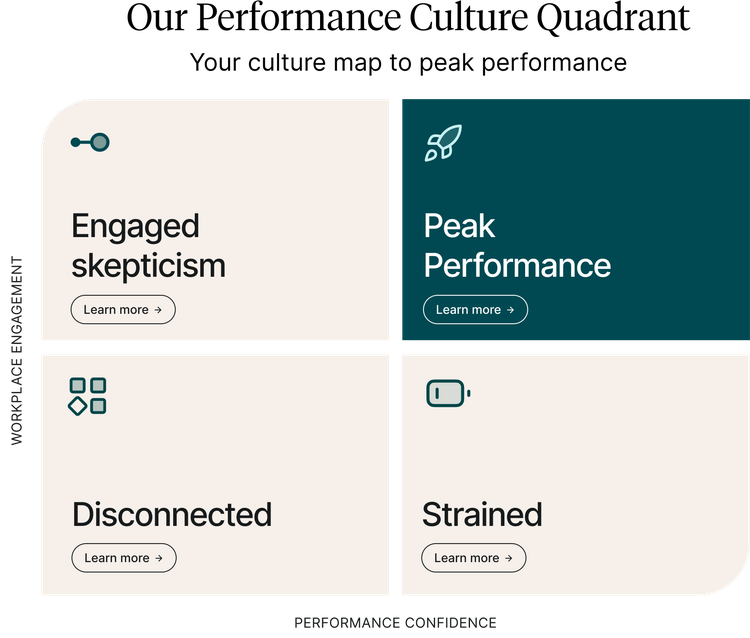
Where a company sits on the two indices places it in one of four culture types in the Performance Culture Quadrant™: Peak Performance, Disconnected, Engaged Skepticism, or Strained.
What drives each outcome
Driver analysis identifies what is most closely related to an outcome, going beyond knowing what is simply the highest and lowest scoring in that bucket.
We found that the two indices share a few drivers, but they also have distinct drivers.
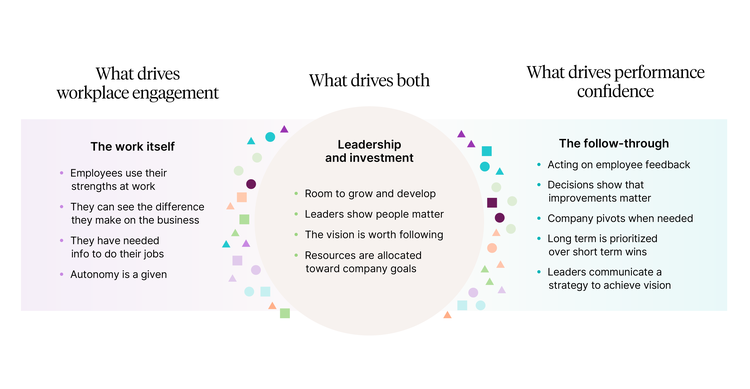
Workplace engagement is driven by the work and the means to do it, while performance confidence is driven by follow-through, or employees’ judgment of the organization itself. Do they know where it’s headed long term, and does it change course when something isn’t working? Both outcomes are driven by leadership and investment. Think: resource allocation and creating opportunities for employees to learn and grow.
That’s where the measuring question comes in. “Our organization prioritizes long-term growth over short-term gains” is a high driver of performance confidence. It’s also one of the least-used questions in the Diagnostic, alongside “Our leaders have clearly explained how we plan to use AI to reach our goals.” Fewer than 1 in 4 companies ask either one.
We can’t tell you why. The survey is new, and companies choose their questions, so the reasons may be mundane. But if you’re designing a culture (opens in a new tab), the questions closest to its drivers are the ones to ask.
No one wants to send out a survey just for the sake of doing it. Checked-box be damned. Rather, organizations send surveys to learn what they’re doing well and where the greatest opportunities lie.
Seeing, for the first time, what aspects of performance culture companies around the world need to improve on was illuminating, though not so surprising.
Where companies have the most opportunity to improve
Even trailblazers have areas where they could do better. Across each of the six dimensions of performance culture, the lowest-scoring items revolved around collective responsibility over silo mentality and removing friction to enable high performance. Maybe “Come Together” by the Beatles will make a comeback in corporate culture. The sentiment could really help right now.
Just half of employees around the world say that their company acts when someone is not delivering in their role (50%). Accountability and managing underperformance are markers of high-revenue growth companies (opens in a new tab) and peak-performance companies as well. While accountability and underperformance aren’t the most fun to address, companies that do see results.
Just above accountability sit decision clarity and AI vision. Only 55% say it’s clear who is responsible for making decisions, and just 58% say leaders have explained how the company plans to use AI to reach its goals.
Luckily for leaders keenly interested in boosting performance culture, the signals from what is working well point to where it’s most effective to direct actions: at people and teams.
Where companies are already strongest
Collectively, the highest-scoring items across each dimension reveal a workforce and core teams that are solid and dynamic. They want to perform, know how to deliver value, and support one another in doing so.
The primary challenge for leadership in this volatile climate is less about motivating staff and more about clearing the path for them. Leaders’ job is to ensure that macro-level structures (clarity on strategy, underperformance management, and resource allocation) match the momentum already present at the team level.
A note about this data! It is well known in survey design that items about your own work and your own manager score higher than items about leadership or the organization as a whole. The phenomenon is known as proximity bias. That said, the better the internal comms at a company, the closer employees will feel even to that which is further away.
These high-scoring items also map to Edward Deci and Richard Ryan’s self-determination theory, which established that human motivation relies on three interrelated needs:
Autonomy to perform and explore new tools
Competence to know how to achieve high performance and see positive impact from it, and
Relatedness to know who to collaborate with and who has your back when you need to take a break
The self-determination suggested in this sample likely acts as a buffer against confusing or unclear strategy or even organizational chaos. There is a tipping point, though. If macro-level frustration eventually overrides local team satisfaction, employees will just leave.
To enjoy the benefits of these high marks and help prevent macro-level frustrations from growing, leaders can recognize and reward mid-level managers who are cultivating these environments.
Where the trailblazing companies land on the Performance Culture Quadrant
Remember that Performance Culture Quadrant we mentioned? Of the 104 companies that asked all eight outcome questions, this is where they landed:
Peak Performance: 42% of companies
Engaged Skepticism: 11% of companies
Disconnected: 38% of companies
Strained: 9% of companies
Four in five sit at the two opposite corners of the quadrant, high on both indices or low on both. It stands to reason that engagement and performance confidence tend to rise and fall together. This is also a self-selected group of early adopters, not a market sample, so 42% isn’t a market share. What it does show is that Peak Performance is a state companies can actually achieve.
And it’s a state worth striving for. In our earlier research (opens in a new tab), which used proxy items for the two indices, Peak Performance companies had a 47-point stock price change advantage, 21% more high-performing employees, and a high 88% retention rate compared with other culture states.
But what is actually happening inside those Peak Performance organizations?
What Peak Performance companies do differently
The largest difference between Disconnected and Peak Performance companies is whether people believe action will follow a survey. It reflects whether a company is the kind of place where feedback loops get closed (opens in a new tab).
Also, employees at Peak companies have better accountability practices, are stronger at innovation, and are getting better communication from leaders.
We also compared behaviors between Peak and Disconnected performance cultures. We found that Disconnected companies set 29% more goals than Peak Performance companies but revisit them less. On the other hand, Peak Performance companies set fewer goals but are 45% more likely to update them with progress, iterating as the strategy and the company’s needs shift.
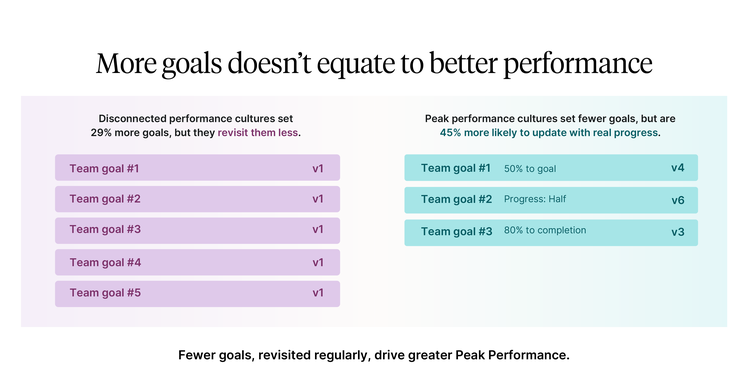
From this, we can gather that setting more goals doesn’t equate to better performance. A smaller number of goals that you come back to regularly is the pattern we see at Peak.
The second behavioral area we looked at was feedback. Disconnected companies are 21% more likely to build peer feedback into their performance evaluation cycles. But Peak Performance companies don’t relegate feedback to annual or biannual reviews.
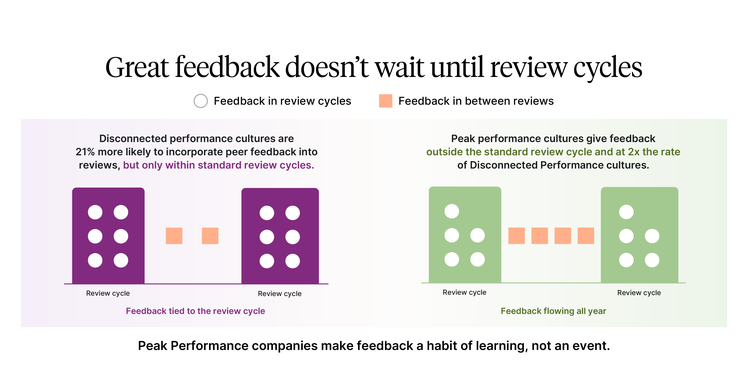
Peak companies give peer feedback (opens in a new tab) outside the cycle at 2x the rate of Disconnected companies. It may be that employees are quicker to ignore feedback that arrives as a box-checking exercise and more likely to learn from continuous feedback that arrives in the moment.
Start closing your loops
These are associations, so we can’t promise that doing these things will move a company into Peak. But a stated plan and a revised goal aren’t the same thing, and Peak companies are the ones revising. Updating goals as the strategy shifts and giving feedback between reviews gives employees something to see and anchor on. Performance confidence is built by visibly closing loops like these, over and over, until people come to understand that this is a place where things get finished.
To get started, pick one loop your organization has left open, and close it. Then, ask the questions your survey hasn’t. Does your organization prioritize long-term growth over short-term gains? Have leaders explained how you plan to use AI to reach your goals? You may not love what comes back, but it’s useful information that tells you where your performance culture is headed.
This is a first look at the Performance Culture Diagnostic benchmarks. The full report, Performance Culture by Design, goes deeper on all six dimensions.

Learn hwat high performance cultures do differently

Unlock the 47% advantage: A guide for modern leaders.
What's next
![new nav visual]()
![Predictions reality check]()
![]() View article
Article
Employee value proposition: What it is and why you need one
Employee experience12 min read