
Article
78 performance review phrases to share effective feedback
Performance management
18 min read
Written by

Lead Data Journalist, Culture Amp
Performance has been the fixation of organizations for a decade. Leaders are under pressure to grow faster, run leaner, lift margins, and capture whatever advantages AI can unlock. All the while, employees everywhere are feeling the pressure to do more, and many are struggling.
At Culture Amp, we hear about the elusiveness of performance from HR leaders every day, which prompted us to go into the lab to answer a simple question: What are organizations that achieve healthy, long-lasting high performance doing differently?
We assumed the key to unlock high performance lived in individuals, so we started our analysis here. However, we found that individual high performance wasn’t sustainable across multiple evaluation cycles. In fact, only 2% of employees globally had sustained two high performance ratings in a row.
That insight, when combined with others we’ve published about Inc. 5000 companies, leadership, connection at work, and changing employee experience trends, led us to two conclusions:
Sustained high performance is a collective property and not an individual trait
Culture drives performance
Once we accepted that we needed to shift our unit of analysis from the individual to the collective, we saw our past roadmap of insights pointing in one direction.
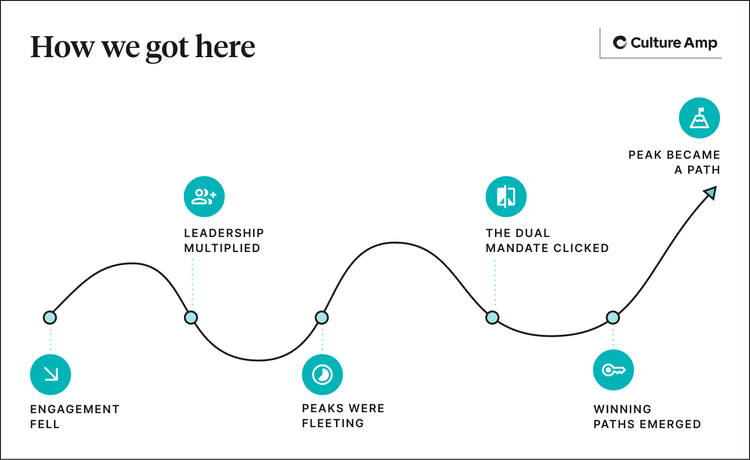
Across billions of data points and decades of research, the insights kept stacking up in the same direction. Engagement was falling year after year, prompting leaders to ask whether measuring it alone was worth the continued investment.
Then the performance multiplier revealed itself through the data: leadership. Strong leaders and managers increased engagement, retention, and the share of high performers across their teams.
And while high-performing employees are the ideal, individual heroics only created short-lived peaks. Sustainable high performance came from the conditions around people. That was when the dual mandate clicked: engagement and performance rise together. Companies that doubled down on codified levers saw more revenue growth.
By pulling together all of our people science research (over 1.6 billion employee responses) and traversing the academic literature from the past 50 years, we finally honed in on what HR leaders have been chasing.
Peak performance is everything wrapped in your culture. It envelops the norms, systems, and everyday behaviors that either accelerate success or quietly obstruct it.
In the organizations we identified as Peak Performance cultures, people are energized by their work. They think what their company offers is best in class and believe it will succeed. That belief matters more than we once assumed. Even though Ted Lasso showed us all how much success hinged on who is willing to “believe,” we had to see it for ourselves in the data. We’re scientists – go figure!
When employees believe the company can win, their own performance lifts. They are more likely to role-model values and bring forward ideas, and probably strive to be in a state of continuous improvement, where they lift others on their ascent.
At the collective level, energy and company confidence compound. That insight became the foundation of the Performance Culture Quadrant.
Yes, it’s a 2 x 2. Stay with us. What sets it apart is what sits behind it. We paired two outcomes that have historically been separated in the market: engagement and performance.
When people bring intense energy to their work (engagement) and truly believe their organization will win (performance confidence), they work with a shared conviction that makes everyone’s success inevitable.
When coupled together, engagement and belief that the company will succeed revealed four distinct culture types.
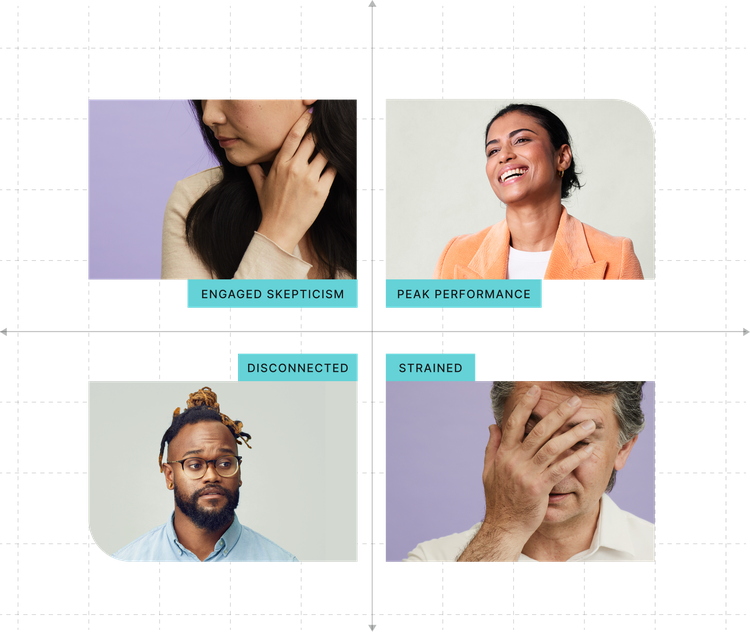
Peak Performance sits in the top right, where high engagement and high performance confidence meet. Employees and teams in Peak are excited to show up. They believe in the strategy and see themselves in the win. In our proxy analysis across 1,800 organizations, 44% of companies landed here.
This, of course, meant that the other 56% landed in the remaining three quadrants and respective culture types. Others landed in:
The Engaged Skepticism culture sits in the top left: High engagement. Low performance confidence. These teams care deeply about their work. The energy is there, but belief in leadership or the direction the company is headed is not. Employees question whether the organization has the right approach to win.
The Strained culture type sits in the bottom right: Low engagement. High performance confidence. Employees believe the company will succeed, and they are pushing hard to get there, but their energy is fading. It’s the closest cultural proxy to burnout. They see the light at the end of the tunnel, yet they’re not sure how long they can sustain the pace.
The Disconnected culture type sits in the bottom left: Low engagement. Low performance confidence. Employee energy is depleted, and belief that they’ll see company success is weak. People and teams in this culture type are likely unclear about how their work ladders up to impact.
These cultural states are neither fixed, nor permanent labels. They are signals of where your culture is now, and where you could be moving forward.
We also examined how stable these cultural states are. Among companies that started in Peak, 76% remained there a year later. For the majority of companies, it’s a durable and sustainable state.
When we uncovered these insights, we were nothing short of jazzed, because they counter the assumption that once you hit the top, the only direction to go is down.
Even more encouraging, roughly a quarter of companies in non-Peak states moved into Peak within a year.
Movement is possible from any starting point. Try it out on the chart above by clicking through the “from” states. This was the unlock we’d been looking for.
To test whether Peak is more than a compelling idea, we validated it against external business outcomes. The results were difficult to ignore.
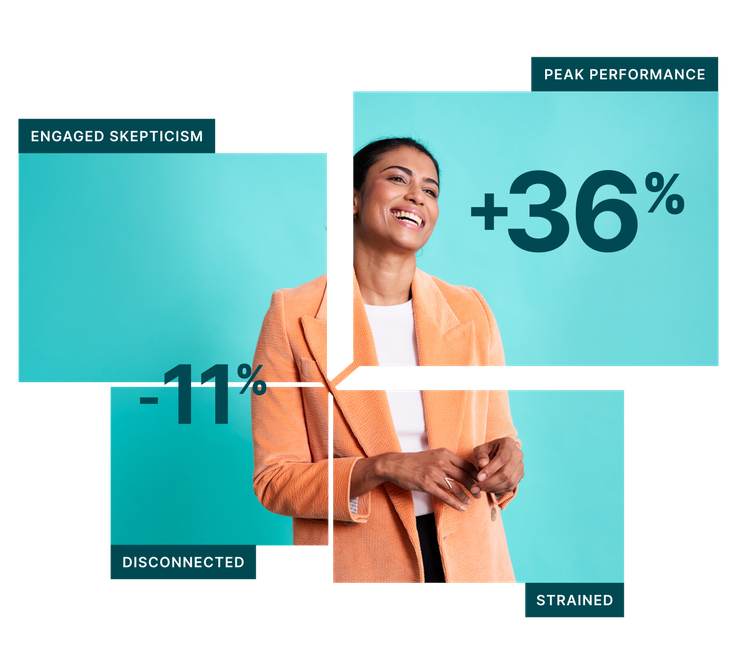
Companies in Peak had 21% more high performers within their workforce compared to others. They also reported retention rates of 88%, which is the highest among all cultural states.
In public companies, Peak organizations showed a median stock price increase of up to 21% over one year, compared to a -4% percent median decline among companies in other cultural states. Over two years, the spread reached 47% points. These figures are directional and not market adjusted, yet the pattern is consistent: Peak cultures outperform.
Because of these findings, we knew we couldn’t just stop at the model. We wanted to build it into an operating system that will enable all companies to reach Peak Performance.
The Performance Culture Diagnostic is grounded in our 15 years of people science research and 1.6 billion employee survey responses. It measures the two outcome indices (workplace engagement and performance confidence) along with six evidence-based dimensions that leaders can influence. These dimensions serve as tangible levers leaders can pull to sustain Peak Performance.
Within the Culture Amp platform, leaders can diagnose their culture, contextualize their results on the Performance Culture Quadrant (PCQ), and see where friction is systemic versus localized. For example, a department might sit in Engaged Skepticism, while the broader organization is in Peak. A cost center might be in Strained, while another is thriving.
And right beside your results sits our AI Coach.
AI Coach is trained on our people science research and knowledge base, enabling it to translate the powerful insights brought forward by the PCQ into guided and actionable change. AI Coach interprets the cultural state, surfaces the most important drivers, and helps leaders prioritize one or two high-impact actions. Leaders can then embed those actions into daily rhythms using goals, 1-on-1s, feedback, and performance workflows.
Culture shifts when behaviors shift, and behaviors shift when systems reinforce them. After activating change, teams can pulse again and watch the dots move on the PCQ.
For too long, the market has focused on boosting individual output. If we can just get employees to give a little more with a little less, performance will follow. But the data tells a different story: Individual performance is cyclical, while collective performance, when rooted in the ideal cultural conditions, is durable.
The PCQ makes culture legible and steerable. It gives leaders a coordinate instead of a hunch. It shows whether the challenge is energy, belief, or both. It proves that:
Peak Performance is attainable
Most companies that reach Peak stay there
Even Disconnected cultures can reach Peak within a year
If you’ve been chasing high performance without a clear map, this is like having GPS guidance. Diagnose where you are. See what matters most in your context. Choose your next right move.
Peak Performance is not reserved for the rare few. It is a cultural state within reach for your company.

Unlock the 47% advantage: A guide for modern leaders.
Article
Article
Article