
Article
Employee attrition: What it is and how to calculate it
Employee engagement
9 min read
Written by

Writer, Culture Amp
If your CEO or CFO has come to you in the past year or two and asked you to justify the company’s investment in culture, you’re not alone. Some organizations put culture first when business is good, but at the first sign of instability, they’re ready to pull back on that investment. When leaders think of culture as a discretionary expense, it’s often because they overlook the value people analytics offers in times of change.
By listening to your employees, you can get visibility into everything from engagement to leadership effectiveness – information that is especially valuable when organizations face difficult decisions and a volatile market.
Roza Jankovic, Ph.D., Lead People Scientist at Culture Amp, has helped companies leverage best practices in workplace culture for more than 15 years. She has a deep understanding of the importance of company culture in navigating uncertainty, and in a recent webinar, she shared her expertise with the Culture Amp community.
Roza believes every organization is currently navigating some kind of uncertainty. She says, “It's just the environment that we're in now. So what we're trying to do is make the case that organizations who cut visibility into leadership, into engagement, into performance, they might not necessarily see the cost immediately, but they will feel it over time, and so it's hard to recover once you're there.”
The World Economic Forum’s 2026 Global Risk Report found that 50% of respondents anticipate a “turbulent or stormy outlook” over the next two years, and 57% felt that way about the next ten years.
Reflecting on that data, Roza says, “We have that saying that the only constant is change,” but she sees today’s companies experiencing a different type and pace of change. “There are forces that are acting on our organizations that make culture data even more valuable today than ever before.”
The constantly changing macroeconomic environment makes it harder for organizations to think long-term. Roza hears from leaders who are criticized for not having a strong, motivating, long-term vision, and she thinks it’s because their organizations are constantly trying to pivot, adjust, and adapt. She notes, “[Constantly pivoting your vision] buys less time to get that messaging right. That buys you less time to ensure that employees are with you.”
People leaders like Roza know that listening to employees through surveys and other tools provides a unique perspective on what’s working and what’s not. She says, “In this environment, the organizations that really can survive, do well, and thrive are the ones who are really good about understanding what's coming. They're the ones that have real-time intelligence to be able to adapt.”
While many organizations are undergoing change right now, they’re not all experiencing the same changes. Roza shared four types of organizational shifts that companies are going through, common challenges associated with each culture shift, and tips for overcoming them.
In a strategic shift, an organization changes its priorities. This might look like anything from sunsetting a line of products to expanding into a new market.
Employees may resist the change if they don’t understand the new vision or the reasoning behind it. Companies can address these concerns by communicating a motivating vision, outlining clear expectations, and encouraging goal-setting that aligns with the new strategy.
A structural shift occurs when an organization reorganizes to better deliver on its strategy. For example, a company might change reporting lines to improve efficiency.
A common challenge here is misalignment and confusion. When employees are asked to change who they collaborate with and modify workflows, they may start to wonder if there’s still a place for them at the company. To alleviate those concerns, check how your communication is landing, and track whether people still see a future for themselves at the company. Referencing Culture Amp data, Roza notes, “The minute people start to doubt [the future], they're much more likely to exit.”
New leaders bring new opportunities – and new challenges. Whether a leader is new to the company or taking on a larger role, they are likely to feel intense pressure.
When leadership changes, employees may question whether the new leader really understands their customers and what it’s like to be on the ground. Roza notes, “It's so easy, in these moments, to lose trust between the leader and the group.” It’s up to the company to manage how the new leader’s message is landing and pay close attention to any changes in employee confidence in leadership.
Learn about the leadership skills that actually matter in 2026.
Operational shifts change how work gets done day to day. This is often the type of shift where companies ask employees to “do more with less.”
The biggest challenges here are ensuring that employees have the right tools and knowledge to succeed as their roles change – and that they don’t feel strained. Companies can address this by checking whether employees feel they have access to the right resources and feel valued for the work they do.
Even if your organization has experienced two or more of the culture shifts listed above, the categories listed above are useful for understanding how different types of shifts can affect employees. Roza says, “The more you can identify what's happening, the better you can identify what you have to watch for and manage, and then you have a way to prioritize.”
The more you can identify what's happening, the better you can identify what you have to watch for and manage, and then you have a way to prioritize.
Roza Jankovic
Lead People Scientist at Culture Amp
Her colleague, Jada Al Aswad, Lead Marketing Campaigns and Content Manager, Culture Amp, shared a few use cases of companies undergoing change.
“Following their historic merger, NASCAR partnered with us to bridge their two cultures into one cohesive workforce,” states Jada. “They employed a crawl, walk, run approach, and dug into their people data. In working with us, they were able to create one united, engaged workforce.”
As part of this process, NASCAR used Culture Amp’s science-backed platform to listen to employee feedback and ensure that decisions were evidence-based and scalable. Jada says, “NASCAR's people team became the driver for business performance, influencing C-suite decisions with robust, trusted data that they could easily act on, and that really propelled them forward.”
Read the full NASCAR case study to learn how the company bridged two cultures.
When Davida Lindsay-Bell joined Hanna Andersson as CPE, the company was also shifting toward digital operations. Jada recalls, “She knew the organization really needed this disciplined, data-driven way to understand what employees were actually experiencing and how to hold leaders accountable for responding and changing the culture in a positive way that would lead to bottom-line success.”
Read the Hanna Andersson case study to find out how the company transformed its culture.
Roza points out that these examples have something in common: “These organizations saw listening and collecting data as a way to build resilient organizations.” They made a point of showing their employees: We take your feedback, act on it, and then respond to your needs. Roza adds, “What that does is, it makes you more resilient, because when an unexpected challenge comes, you already have that mechanism and trust built in. You're not all of a sudden struggling to try to see what's going on.”
Jada adds, “You're using that data to inform future decisions, and you're using it as a sort of early-warning diagnostic tool.” Both NASCAR and Hanna Andersson used employee data and feedback to guide their next steps to set their culture up for success.
Culture Amp recently announced a new way to visualize the relationship between workplace engagement and performance confidence – the Performance Culture Quadrant (PCQ). Backed by people science, it looks at your engagement and performance confidence numbers together, and then shares targeted actions to guide your company toward a culture of sustainable high performance.
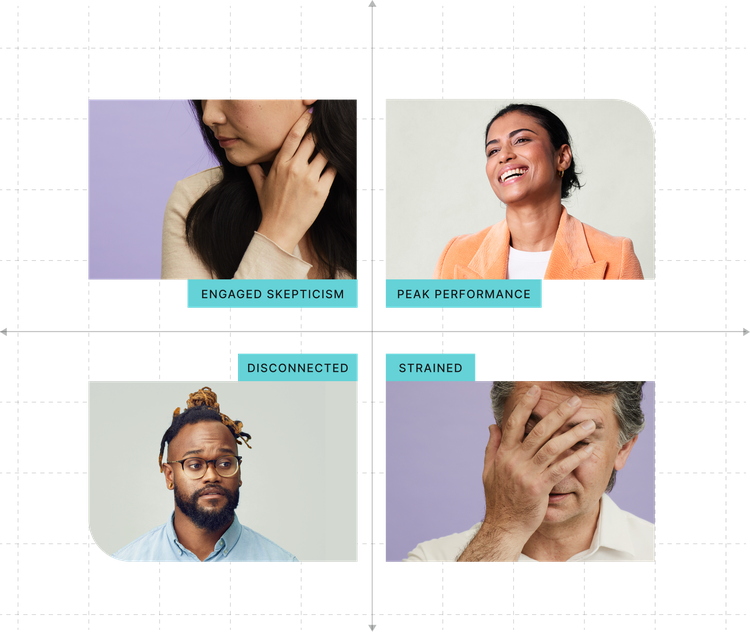
While many organizations measure employee engagement or performance confidence, Roza explains, “We at Culture Amp are arguing you need to do both, especially in today's climate, because this is how you get a better sense for what your culture is capable of sustaining and maintaining when it comes to high performance.”
Some of Culture Amp’s customers have been surprised to see where they place on the PCQ, but no matter which quadrant you’re in, you’ll learn what steps to take to achieve Peak Performance as an organization. “While we all want to be in Peak, I can tell you, not everybody is there. But with the right tools, we can assess where we are and get there,“ notes Roza.
If senior leaders ask you to justify the company’s investment in culture, you have an opportunity to reframe how they think about it. Start by connecting the data’s value to the business as a whole. Roza says, “It's so easy for us to stay in our own worlds and think of this as HR space, but culture data is not just HR data. It's business intelligence.”
It's so easy for us to stay in our own worlds and think of this as HR space, but culture data is not just HR data. It's business intelligence.
Roza Jankovic
Lead People Scientist at Culture Amp
If you’re asked to cut programs, share a cost assessment that connects the importance of company culture with issues leadership cares about. Culture Amp’s employee experience ROI calculator is a great place to start.
If leaders are worried that new data will reveal something they’d rather not see, encourage them to measure it anyway. Roza explains, “It's worse to not know where you are, because you will still be there, but having the data actually lets you do something about it.” As leaders review the findings, they’ll find ways to improve, and they may even uncover opportunities for quick wins.
Instead of cutting culture, start making the most of your people data. Culture Amp’s CultureOS can help you make decisions, create long-term plans that motivate employees, and improve your bottom line.


Unlock the 47% advantage: A guide for modern leaders.
Article
Article
Article