
The complete guide to employee lifecycle surveys

Written by

Writer, Culture Amp
In this blog
Your employees’ relationship with your organization is always evolving. They start out as a new hire, but before long, they could become a tenured employee, a departing team member, or even a boomerang employee who comes back for more.
The employee lifecycle is a useful framework for understanding the changing relationship between an individual and their organization: from attraction and onboarding through ongoing performance and development to their eventual exit. By listening at meaningful moments throughout the lifecycle, your organization can better understand employees’ needs, how well you’re meeting them, and where there are opportunities to improve.
Let’s explore the stages of the employee lifecycle and how to build an employee listening strategy around the moments that matter.
Key insights
The employee lifecycle is a framework for understanding the relationship between an employee and an organization, from the employee’s first interaction with the company through their departure and beyond.
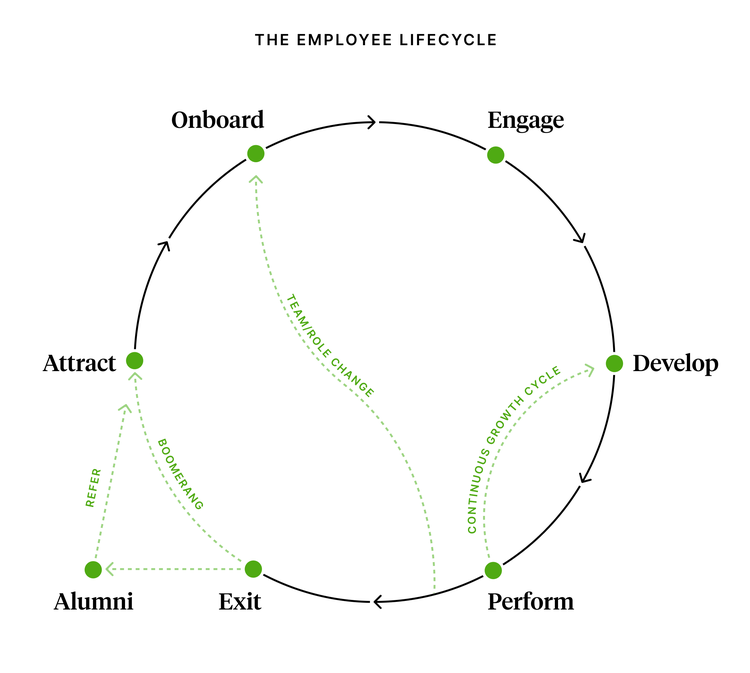
The Culture Amp employee lifecycle model has seven stages: attract, onboard, engage, perform, develop, exit, and alumni.
Common employee lifecycle surveys include onboarding, engagement, pulse, stay, and exit surveys.
What is the employee lifecycle?
The employee lifecycle, or employee experience lifecycle, is a framework for understanding the relationship between an employee and an organization, from the employee’s first interaction with the company through their departure and beyond.
Most employee lifecycle models have six to 11 stages, but there’s no magic number. What matters is choosing the stages that make sense for your organization and help you grasp how these moments shape your employees’ experience.
It’s also important to remember that an employee lifecycle isn’t linear. Employees can move between stages, experience several stages at once, or revisit an earlier stage as their roles and circumstances change. For example, an employee might go through a second onboarding period after an internal move while also focusing on development.
Understanding the employee experience lifecycle helps you recognize what employees need at key points in their journey, identify opportunities for improvement, and determine where listening and action can have the greatest impact.
Employee lifecycle vs. employee experience vs. employee engagement
Employee lifecycle, employee experience, and employee engagement are closely related, but they’re not interchangeable. We’ve covered the employee lifecycle above, so let’s look at the other two:
Employee experience: The broad set of interactions and conditions that shape an individual's experience at your company
Employee engagement: A metric that represents the level of enthusiasm and connection employees feel toward their work and organization
This distinction matters when it comes to employee surveys. An engagement survey is a type of lifecycle survey that specifically measures employee engagement and the factors that influence it. Other lifecycle surveys gather feedback at a particular stage or moment in the employee journey, like onboarding or exit. That means a lifecycle survey might explore an employee’s experience at a particular moment without measuring engagement.
For example, an onboarding survey could ask whether a new employee received the information, support, and resources they needed to get started. Those questions tell you about the onboarding experience, but they aren’t necessarily measures of employee engagement during onboarding.
The 7 employee lifecycle stages
Again, most employee lifecycle models have between six and 11 stages. Culture Amp’s model has seven: attract, onboard, engage, develop, perform, exit, and alumni.
Here’s a brief look at each employee lifecycle stage and what it involves:
| Employee Lifecycle Stage | Description |
|---|---|
| Attract | How prospective employees discover your organization and form their first impressions of what it might be like to work there |
| Onboard | How new employees are welcomed, supported, and trained as they settle into their roles and the organization |
| Engage | How connected and motivated employees feel about their work and your organization |
| Develop | How employees build their skills, grow in their roles, and pursue learning and development opportunities |
| Perform | How employees understand expectations, receive feedback, and get the support they need to perform effectively |
| Exit | What happens when an employee decides to leave or their employment ends, including understanding the reasons behind their departure |
| Alumni | How the organization manages an employee's transition out of the company and maintains the relationship after they leave |
What are employee lifecycle surveys?
Employee lifecycle surveys gather feedback at specific moments or stages of the employee journey. Depending on what you’re hoping to learn, your employee lifecycle management program might include:
Onboarding surveys, which explore how new employees experience joining your organization.
Engagement surveys, which measure employees’ broader experience of work and the conditions that support engagement.
Pulse surveys, which use a shorter set of questions to explore a particular topic and track changes over time.
Stay interviews, which help you understand what keeps employees at your organization and what could improve their experience.
Exit interviews, which gather feedback from departing employees.
The goal isn’t to measure every moment of the employee experience, but to understand your employees’ needs well enough to improve their experience. The right mix of surveys depends on your organization’s priorities and its capacity to respond to what employees share.
With over 40+ science-backed survey templates covering the entire employee lifecycle, Culture Amp’s ready-to-use surveys help you gather feedback at key moments so you can understand engagement, retention, employee performance, DEI, and more.
Why is measuring the employee lifecycle important?
Measuring the employee lifecycle helps you understand how employees experience key moments at your organization and where you have opportunities to make those experiences better. Here are a few reasons why employee lifecycle management matters:
Employees want to share feedback: Your employees want to help you improve. Regular employee lifecycle surveys for HR give your workforce the ongoing opportunity to share what’s working and how their experience could be improved. And when you act on what you hear from employees, it shows that your organization cares and wants to do better for them.
You gain actionable insight into the employee experience: Lifecycle surveys can reveal how employees experience important moments, and tracking this feedback over time can help you spot patterns and identify areas of improvement.
Spot issues earlier: Pulse survey data can help you identify problems when they occur, rather than waiting for an annual survey or an exit interview to uncover them. This allows you to proactively address problems before they become larger systemic issues.
You can take more targeted action: Survey insights can help you focus your efforts where they will drive the most meaningful difference. Instead of guessing what needs to change, you can use quantitative and qualitative employee feedback to take informed action.
How to run an effective employee lifecycle survey
Ready to build employee lifecycle surveys into your listening strategy? Follow these six steps to collect meaningful feedback and turn it into action.
1. Start with a strategy
More surveys don’t necessarily lead to better insights. Survey your employees too often without acting on the results, and you risk creating survey fatigue and eroding employees’ trust.
Before launching a survey, get clear on what you want to learn and why. Consider how you’ll use the feedback, who will review the results, what decisions the findings could inform, and whether your organization has the resources to act on what you learn. This lays the groundwork for a successful employee lifecycle management strategy.
2. Ask questions that match the moment
Each employee experience lifecycle survey should explore a specific experience rather than forcing every stage into the same survey template. An onboarding survey, for example, should focus on the experiences that matter to a new employee, while an exit survey should ask about an employee’s experiences as they leave.
Aim to create an employee lifecycle management listening strategy that is:
Purposeful: Give every survey a clear objective and audience.
Relevant: Ask questions that reflect the specific experience you want to understand.
Timely: Collect feedback when employees can meaningfully reflect on that experience.
Action-oriented: Focus on feedback that can inform decisions or improvements.
Transparent: Tell employees why you’re asking for feedback and how you’ll use it.
Proportionate: Ask only about things your organization can reasonably interpret and act on.
Need help finding the right questions? Check out our article on 11 tips for writing great employee survey questions, so you can spend less time debating what to ask and more time learning from the results.
3. Choose the right employee survey tool
You can run employee experience surveys manually, but the right survey platform makes it easier to scale your listening program, automate administrative work, and reduce your time-to-insight.
If you’re evaluating employee survey tools, consider solutions with the following features:
Automated triggers: Send surveys and reminders based on milestones, such as hire or exit dates, without having to manually hit send.
Stage-level reporting: Explore results for specific lifecycle moments and employee cohorts to understand where experiences differ.
Action-planning workflows: Turn survey findings into clear actions with specific owners and next steps.
Confidentiality protections: Give employees appropriate confidentiality so they feel comfortable sharing candid feedback.
AI-powered insights: Quickly summarize employee comments, analyze survey results, and generate potential next steps so you can spend less time interpreting feedback and more time taking informed action.
Culture Amp brings employee listening, analytics, and action planning together in one platform, helping you gather feedback across the employee lifecycle and turn it into meaningful action. See how it works by requesting a Culture Amp demo.
4. Look for trends in your results
Once the responses are in, look for common themes across employees, teams, and over time. These patterns can help you pinpoint parts of the employee experience that may need attention.
For example, onboarding surveys might show that new employees consistently struggle with role clarity, while exit surveys could reveal that the same issue comes up when employees leave. Look at survey scores alongside employee comments and other context to understand what’s happening and decide where to take action. Use these patterns to better understand team and organizational conditions, not to label individual employees or predict what one person will do next.
5. Share what you learned
Collecting feedback is only the beginning. Employees also need to know that their voices are being heard. Culture Amp's 2025 benchmark data shows a growing gap. Since 2021, the share of employees who say they've had a chance to see and discuss survey results has risen from 60% to 66%, while the share who believe action will be taken has fallen from 62% to 57%.
Share key findings at the appropriate level, whether that’s across the organization, or within a department or team meeting. Be transparent about what you learned, what you plan to address, and what might not change right away, so employees have visibility into scores and your post-survey action plan.
6. Turn feedback into action
Lastly, close the feedback loop by turning what you’ve learned into action. You don’t need to address every finding at once. Instead, prioritize a manageable number of opportunities, explain to employees why you chose them, and assign clear owners to each action. Then, keep employees updated on your progress so they can see how their feedback is making a difference.
Following through matters. When employees take the time to share feedback, they want to know what came of it. Culture Amp found that organizations that shared survey results saw participation in their next survey increase by an average of 7 percentage points. By sharing what you learned, what you’re doing about it, and what happens next, you can show employees that speaking up is well worth their time.
Employee lifecycle survey best practices
An effective employee lifecycle survey program isn’t about surveying employees at every possible moment. It’s about listening with purpose, considering that feedback in context, and acting on what you learn. Keep these five best practices in mind as you build your approach.
Treat the lifecycle as a flexible framework
It’s easy to assume that employees move through the employee lifecycle in a fixed order, or that tenure alone tells you what someone needs. In reality, employees may move between stages, revisit a previous stage, or experience several stages at the same time.
Use employee lifecycle stages as a flexible framework for identifying meaningful moments and employees’ experiences within them. The goal isn’t to fit every employee into the same journey, but to recognize that people’s paths (and what they need from your organization along the way) can vary.
Conduct surveys with a clear purpose
More surveys don’t necessarily lead to better insights. Instead of surveying at every possible touchpoint, build an intentional listening strategy around the key moments you want to understand and improve. A smaller, coherent listening program can be more valuable than frequent surveys that create fatigue without driving meaningful change.
Name surveys according to what they measure
Not every employee experience lifecycle survey is an engagement survey. Onboarding, candidate, training, performance, and exit surveys gather feedback about specific experiences or moments in the employee lifecycle. Only use the label “engagement survey” when the survey is designed to measure employee engagement. Otherwise, name it according to the experience you’re trying to understand.
Put exit feedback in context
Exit surveys can provide valuable insight into why employees leave, but they’re only one source of evidence, not a definitive explanation for turnover. To build a more holistic picture of why employees leave, consider exit feedback alongside other quantitative and qualitative data, such as engagement survey results, employee comments, and trends over time. Looking across multiple sources can help you identify patterns and make more informed decisions about what to change.
Look beyond a single score
A headline score or benchmark can be a useful signal, but it can’t tell the whole story of the employee experience. Rather than chasing a single score, build a fuller picture of life at your organization by combining quantitative results with comments, trends, participation context, organizational knowledge, and follow-up conversations. Together, these signals can help you comprehend the employee experience across the lifecycle and identify where action could have the greatest impact.
How Culture Amp supports listening across the employee lifecycle
Every stage of the employee lifecycle offers an opportunity to better understand your people and improve their experience. The key isn’t to survey employees at every possible moment, but to listen with purpose, ask the right questions, and turn what you learn into meaningful action.
Culture Amp makes it easier to do just that. With science-backed survey templates, automated onboarding and exit surveys, powerful analytics, and AI-powered insights, you can gather feedback at the moments that matter and quickly determine where to focus your efforts.
Ready to build a more effective employee listening strategy?
See how Culture Amp platform can help you listen and take action across the employee lifecycle.
FAQ
What are the 7 stages of the employee lifecycle?
Employee lifecycle models vary, typically including from six to 11 stages. Culture Amp's model uses seven: attract, onboard, engage, develop, perform, exit, and alumni.
What is the difference between an employee lifecycle survey and an employee engagement survey?
An engagement survey is one type of employee lifecycle survey. It specifically measures employee engagement and the factors influencing it, while other lifecycle surveys gather feedback at a particular stage or moment in the employee journey, like recruitment or development.
What are the different types of employee lifecycle surveys for HR?
Different types of employee lifecycle surveys include onboarding surveys, engagement surveys, pulse surveys, and exit surveys.
How do you improve employee lifecycle survey participation?
You can improve employee lifecycle survey participation by keeping surveys short and sending them at a reasonable frequency, clearly communicating why employee feedback matters, protecting confidentiality, and showing employees how previous feedback led to action.

Unlock the 47% advantage: A guide for modern leaders.
What's next
![Meet Enso by Culture Amp blog]()
![]() View article
Article
How, when, and why to run an employee benefits survey
Employee engagement13 min read![Two women sitting across from each other]() View article
Article
78 performance review phrases to share effective feedback
Performance management18 min read