
Article
How, when, and why to run an employee benefits survey
Employee engagement
13 min read

Written by

Writer, Culture Amp
Employee engagement is the level of enthusiasm and connection your employees have with your organization. It’s a measure of how motivated people are to put in extra effort and a sign of how committed they are to sticking around.
It’s a powerful indicator of performance and retention. But how do you actually measure it? Employee engagement surveys play a key role here. They help you accurately gauge – rather than guess – how people are feeling about their roles, their teams, and your organization as a whole.
Of course, surveys are only as effective as the questions you ask. To uncover actionable insights, you need to be intentional about what you measure. Below, we’ll walk through a list of employee engagement survey questions to ask, along with practical guidance to help you get the most out of your survey efforts.
The best employee engagement survey questions assess pride, commitment, motivation, leadership, enablement, alignment, development, and the likelihood that individuals will recommend their workplace as a great place to work.
Effective engagement surveys combine science-backed scale questions with open-ended employee engagement survey questions, helping you turn quantitative and qualitative feedback into meaningful action.
Engagement doesn’t improve from collecting data alone. It improves when leaders and managers use survey insights, supported by tools like AI-powered analysis and coaching, for consistent follow-through.
Here at Culture Amp, we consider ourselves experts on employee engagement survey topics and questions. All of our ready-to-use survey templates are built by our people scientists and organizational psychologists to help you get to the heart of what you really need to know.
We pull together this data twice a year to identify employee engagement trends and bolster our benchmark research. For every question, we provide benchmark scores so you can understand what a “high” or “low” score looks like across companies and industries and contextualize your own employees’ responses.
The following recommended questions for an employee survey are thoughtful, intentional, and science-backed, so you can collect feedback that leads to real progress (and not just more data). We’ve broken the questions into four categories:
Employee engagement index questions
Leadership, enablement, alignment, and development (LEAD) questions
Company confidence questions
Open-ended questions
Let’s get started with what we consider the basic building blocks: our engagement index.
The first five sample employee engagement survey questions represent our “engagement index.” We believe that understanding employee engagement takes more than one question. Our index combines questions that focus on the following key outcomes of employee engagement:
Pride
Recommendation
Present commitment
Future commitment
Motivation
We measure these outcomes by asking employees to rate their agreement with the following statements.
This question is colloquially called the “barbecue test,” as in, would an employee be proud to tell someone where they worked if asked at a barbecue? Scores on this question reflect levels of brand and mission affiliation and can give you insight into how your external brand is viewed internally.
Benchmark range (between the 40th and 60th percentiles): 81-86% agreement
Low score (bottom quartile percentile): 76% agreement or lower
High score (top quartile percentile): 90% agreement or higher
This is our version of the Employee Net Promoter Score (eNPS) question. The eNPS was launched in 2003, and some companies use it as their sole indicator of employee engagement. However, we don’t find it robust enough as a standalone measure. For instance, people might recommend your company while still planning to leave. Likewise, they might be unsatisfied with their role but would still recommend your company because of high pay or desirable perks.
Benchmark range: 77-83% agreement
Low score: 72% agreement or lower
High score: 87% agreement or higher
This question gets at an employee's present commitment to your company. It's sometimes a nice reality check for companies with high scores on the other engagement index questions. People who are engaged at work often find that looking for a job elsewhere hasn’t crossed their minds.
Benchmark range: 53-59% agreement
Low score: 48% agreement or lower
High score: 64% agreement or higher
For this question in particular, we recommend looking for variation across demographics (i.e. are women less committed to your organization than men?).
This question also measures commitment but focuses on a specific time frame. An employee who isn't currently looking for a job at another company isn't necessarily an employee who intends to stay for another two years. Questions three and four give us a comprehensive view of present and future commitment, which we use to calculate an overall retention index.
Benchmark range: 64-69% agreement
Low score: 59% agreement or lower
High score: 74% agreement or higher
If your score is higher on this question than on the one above, you can somewhat discount concerns about retention. However, these two questions tend to move together and are usually a fair measure of retention.
This question measures discretionary effort and assesses whether your company motivates people to do their very best. In industries where tenure is traditionally low, this question is particularly important. For example, this would be a key question for a seasonal workforce in which low scores for “I see myself still working at [Company] in two years’ time” would not raise any concerns.
Benchmark range: 64-70% agreement
Low score: 59% agreement or lower
High score: 75% agreement or higher
After our engagement index, we ask questions about the four main factors that drive employee engagement:
Leadership: Do your employees see their leaders as inspiring and effective?
Enablement: Do your employees have what they need to perform well?
Alignment: Do your employees feel connected and appropriately involved with your organization’s operations?
Development: Do your employees have opportunities to learn and grow?
Here’s a closer look at some employee survey question examples we ask in each of those categories.
It’s hard for employees to feel enthusiastic and committed if they don’t understand what’s happening or why their work matters. Including this question in your engagement surveys for employees illuminates whether or not your company leadership is doing a solid job with open and honest communication.
Benchmark range: 67-73% agreement
Low score: 61% agreement or lower
High score: 78% agreement or higher
Rather than asking specifically about the relationship between a manager and their direct report, this question examines how people see their manager within the broader context of the company. Does their manager offer coaching, guidance, and encouragement – or are they purely a supervisor and order-giver?
Benchmark range: 79-83% agreement
Low score: 75% agreement or lower
High score: 86% agreement or higher
Disappointed with your company’s scores for this question? Take it as a sign that you need to upskill your managers. Culture Amp’s AI Coach equips them with instant insights, expert coaching, and targeted action plans, so they can better motivate their employees.
For this higher-level statement to be accurate, people need to first feel informed about what is happening at the company (as reflected in question six). Only then will they feel motivated by or connected to something "bigger" than their day-to-day work. Driving motivation is crucial for increasing employee engagement.
Benchmark range: 62-69% agreement
Low score: 55% agreement or lower
High score: 75% agreement or higher
Answers to this question will help you understand whether employees feel genuinely valued by senior leadership. Do leaders back up their words with actions, recognition, and investment in their people? When employees believe they matter to the organization’s success, trust rises – and engagement follows.
Benchmark range: 66-73% agreement
Low score: 59% agreement or lower
High score: 79% agreement or higher
This question is self-explanatory: Do people have what they need to do their work and develop? This is a crucial hygiene factor, meaning you can’t move forward without it. It's worth noting that we've intentionally used the broader word “things” here rather than “resources” or “tools.”
Benchmark range: 75-80% agreement
Low score: 71% agreement or lower
High score: 84% agreement or higher
This question goes deeper than the previous question. Put simply: Are learning and development opportunities (like training and information, coaching, or intellectual and emotional support) available to your employees? People need more than the right resources. They also need access to the right experiences to learn and grow. How people respond to this question is important, as learning and development is a consistent driver of employee engagement across industries.
Benchmark range: 71-76% agreement
Low score: 65% agreement or lower
High score: 80% agreement or higher
If question 10 is about having the right things, and question 11 is about having the right development, this one is about clarity. Even well-equipped and well-trained employees can feel stuck if they’re constantly hunting for updates, decisions, or documentation. This question will show you whether communication flows smoothly across teams and whether important information is easy to find and understand. This helps people move faster, make better decisions, and focus their energy on meaningful work – instead of chasing answers.
Benchmark range: 72-77% agreement
Low score: 67% agreement or lower
High score: 80% agreement or higher
We’re intentionally avoiding using absolutes in this question, opting for "most" instead of "all." Even the greatest companies will struggle to achieve a state where all systems and processes work perfectly. This question asks: On top of the things people need to get work done (question 10) and the learning and development opportunities needed for people to succeed (question 11), does a company-wide infrastructure exist that enables all of this to happen?
Benchmark range: 61-67% agreement
Low score: 55% agreement or lower
High score: 73% agreement or higher
Enablement is just as much about trust as it is about access. This question measures whether employees feel empowered to make decisions and take ownership of their work. When people have the right level of autonomy, they can respond quickly, innovate confidently, and stay motivated.
Benchmark range: 81-85% agreement
Low score: 78% agreement or lower
High score: 89% agreement or higher
People need to know what they must do to be personally successful at work. This basic level of understanding must exist before people can further develop their alignment with the company.
Benchmark range: 85-88% agreement
Low score: 82% agreement or lower
High score: 91% agreement or higher
Once people know what they need to do to be successful, they deserve to be appropriately recognized for their achievements. If people don't get any praise or acknowledgement for making progress, it's hard for them to stay motivated. Like in the alignment section, scores for this question can be influenced by how people feel about the previous question. Recognition is also a more challenging target for companies to reach, which is reflected in the benchmark data.
Benchmark range: 66-71% agreement
Low score: 61% agreement or lower
High score: 75% agreement or higher
When we initially wrote this question, we visualized engineering teams. But, over time, we've found these values to ring true across departments and roles, as it hits on a top driver of engagement – especially for high-performing, financially successful companies.
Benchmark range: 64-71% agreement
Low score: 59% agreement or lower
High score: 76% agreement or higher
Asking this question can help you understand whether employees feel included in conversations that affect their roles, priorities, and outcomes. When people feel heard and consulted (rather than surprised by top-down decisions), they’re more likely to feel ownership over their work and committed to the results.
Benchmark range: 69-73% agreement
Low score: 65% agreement or lower
High score: 77% agreement or higher
Employees are more engaged when they can clearly connect their day-to-day responsibilities to the bigger picture. This question measures their visibility – whether people understand how their efforts move the organization forward. When that connection is strong, motivation and focus increase.
Benchmark range: 88-91% agreement
Low score: 85% agreement or lower
High score: 93% agreement or higher
This question examines the one-on-one level interactions that help people feel like they can develop at the company. It’s great when managers have technical competence and can share those skills with their team, but employee development is arguably more important for any employee's success. For that reason, it's important for managers to focus on development during 1-on-1 meetings. Culture Amp’s AI Coach can help them strategize, plan for, and even practice for these development conversations.
Pay close attention to how employees answer this question, as development is important for driving motivation, engagement, and retention. Our people scientists have found that when people believe good career opportunities are available to them, they’re more engaged at work. We try to avoid words like “upwards” or “advancement” – which connote a higher level. The “right” opportunity may constitute a lateral move to a different department at the same level. This language is essential in less hierarchical organizations.
Benchmark range: 69-74% agreement
Low score: 65% agreement or lower
High score: 78% agreement or higher
While question 20 focuses on conversations and interactions, this one zooms out to understand the employee’s overall perceptions. Do they genuinely believe they can build a future with your organization? This doesn’t just mean climbing the ladder – it can include lateral moves, stretch projects, skill-building experiences, or new responsibilities that align with their strengths and interests. When people can see a path forward, they’re far more likely to stay engaged and invested in their work.
Benchmark range: 57-63% agreement
Low score: 51% agreement or lower
High score: 68% agreement or higher
This question was inspired by author Dan Pink’s idea of mastery. It asks: Does the company contribute to your development in your craft or industry? This question is frequently one of the top drivers of engagement, as people are deeply motivated by the opportunity to improve, refine their skills, and grow in meaningful ways.
Benchmark range: 71-76% agreement
Low score: 66% agreement or lower
High score: 80% agreement or higher
Last but not least, we often include questions to gauge employees’ confidence in their organizations on the whole.
Culture Amp research found that employees who are confident that their organizations are appropriately directing resources toward organizational objectives are more likely to be engaged. This makes sense, as you wouldn’t want to invest your time and energy into an organization that isn’t using its resources wisely.
Benchmark range: 56-65% agreement
Low score: 50% agreement or lower
High score: 71% agreement or higher
Not only is it important for employees to believe that the organization is using its resources well, but they also need to see a future in which the organization is succeeding. Why invest in working at a company where the rewards of your labor won’t pan out in the longer term?
Benchmark range: 69-76% agreement
Low score: 61% agreement or lower
High score: 81% agreement or higher
These questions are all designed to solicit open-ended feedback and allow people to provide general comments. Responses to these questions tend to focus on tangible things (like your work environment), but employees may also give you feedback on leadership, development, and more. If many people feel that the survey didn't address a particular topic of interest, consider including new questions focused on that topic in the future.
The value of including open-ended questions in a survey for employees is that they provide qualitative data to complement the quantitative data from the scale-based questions. However, you can also provide an optional area for employees to add open-ended feedback to expand on their answers to scale-based questions.
Employee engagement impacts every aspect of your organization – your productivity, company performance, organizational culture, employee retention, and more. So, why would you leave it to chance or best guesses?
By measuring employee engagement, you can:
Improve key business outcomes: Studies show that companies with high engagement scores also experience better business performance and increased innovation.
Collect feedback at scale: Employee engagement surveys enable teams to collect data on employee sentiment across the organization, empowering them with information that represents the collective voices of your employee base (rather than the loudest voices of a few people).
Take informed action on improving company culture or people's experiences at work: If you’re not offering a way for people to provide feedback internally, you’re missing out on the opportunity to improve your employee experience and company reputation. For example, unhappy employees may take to social media or public review sites like Glassdoor to voice their opinions – but only after they exit the company.
Understand areas of improvement: Employee feedback will help you flag areas of improvement before they become detrimental. With a regular cadence of surveys, you’ll also learn more about what’s motivating people to go above and beyond at your company and why they're choosing to stay.
Running an engagement survey and asking the right questions are two crucial first steps. But you also need to manage the process effectively. Here are a few best practices to help you make the most of your engagement survey.
Effectively communicate about the survey. Communicating the what, why, how, and when of your survey is essential for encouraging employees to participate and provide open and honest feedback.
Be cognizant of survey length. Be considerate of your employees’ busy schedules. In our experience, surveys should take no longer than 10 minutes to complete. Any longer, and employees may “rush” to complete the survey, giving you either inaccurate or incomplete answers.
Only ask questions you feel prepared to take action on. If you want your employees to share candid feedback, you need to be prepared to act on what they share. People expect their feedback to lead to tangible changes. As our former CEO and co-founder, Didier Elzinga, said, “The most typical reason people don’t want to fill out your survey is that you haven’t done anything since the last one. They don’t have survey fatigue – they have lack-of-action fatigue.”
Mobilize managers. Managers are usually the people employees have the most 1-on-1 time with. As a result, they are also the people best positioned to communicate the importance of taking the survey. Culture Amp’s AI Coach can help managers figure out the best way to communicate the survey and discuss results.
Run your survey multiple times. A one-time survey won’t offer insight into how your people strategy is or isn’t working. To see how your company’s actions impact your employee experience, run surveys more than once to establish a baseline. This allows you to create internal benchmarks and see how employee perceptions change over time.
Feedback doesn’t do much good if you can’t make sense of it. AI-powered insights can help you identify key performance drivers, prioritize critical engagement trends, and act on insights faster. With AI, you can instantly transform even open-ended survey comments and feedback into clear action plans.
For managers, interpreting engagement data and knowing what to do next isn’t always straightforward. Culture Amp’s AI Coach supports leaders by translating survey results into clear, targeted recommendations and practical next steps. It can help managers prepare for follow-up conversations, identify relevant development opportunities, and build action plans that address the specific engagement drivers within their teams.
In short, AI doesn’t substitute the human side of engagement – it supports it.
For all of our questions (except free-text-only responses), we use a 5-point Likert scale that measures agreement with a statement. Why five? Good question.
There is ample academic research that debates the pros and cons of various point scales. We’ve found that a 5-point scale encourages survey participation (fewer choices means it’s faster to complete) and gathers the right amount of detail. A more detailed scale could add more nuance to your survey results, but we’ve found that it’s sometimes an unnecessary amount of detail. A consistent 5-point Likert scale is enlightening, without being too cumbersome.
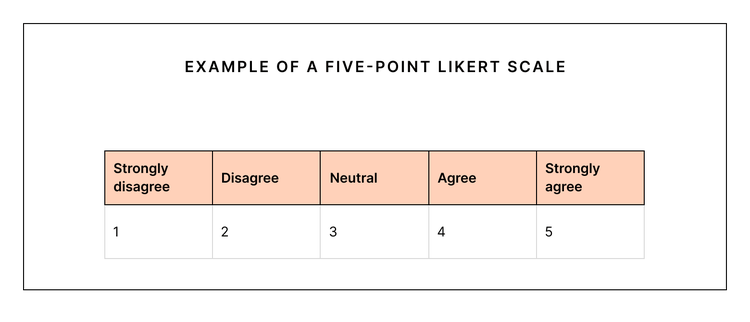
For example, the survey-taker is presented with the statement: “I am proud to work for (Company).”
They then choose from a scale of agreement with the following options:
Strongly disagree
Disagree
Neither agree nor disagree
Agree
Strongly agree
Using a consistent Likert scale throughout your engagement surveys for employees helps people build familiarity with the scale, so they can answer questions more easily. We also think it’s important to have levels of agreement rather than just a number-based scale, as different people will interpret a 1-5 numerical scale differently. To further reduce ambiguity, our questions are all phrased to identify the ideal state (for example, again, “I am proud to work for this company”).
In addition to the Likert scale, we include a field to collect open-text responses with each question. We encourage this for all employee surveys (not just your annual or biannual engagement survey) because it allows you to tap into quantitative and qualitative employee feedback.
Employee engagement won’t improve just because you ran a survey. It improves when you ask the right questions, actively listen to the answers, and follow through with appropriate action.
When your employee engagement survey questions are thoughtful, science-based, and tied to clear next steps, feedback transforms from data to direction.

Uncover the areas that will drive meaningful work for your employees and maximize impact to your business with flexible survey templates, industry-leading insights, and powerful analytics.
Our standard employee engagement survey includes 57 questions. That’s typically enough to cover key engagement drivers – like leadership, enablement, alignment, and development – without overwhelming employees. As a rule of thumb, your survey should take no longer than 10–15 minutes to complete.
Many organizations run a comprehensive engagement survey annually, with shorter pulse surveys quarterly. The right cadence depends on how quickly your organization can review results and take action. Consistency matters more than frequency.
Employee satisfaction surveys measure how content employees are with aspects of their jobs, such as pay or benefits. Employee engagement surveys go deeper, assessing motivation, commitment, discretionary effort, and emotional connection to the organization.
Share high-level results, identify a small number of priority areas, and create clear action plans. The most successful engagement surveys lead to visible follow-through. Employees are far more likely to participate in future engagement surveys when they see that their feedback inspired real change.

Unlock the 47% advantage: A guide for modern leaders.
Article
Article
Article