
Article
How, when, and why to run an employee benefits survey
Employee engagement
13 min read
Written by

Senior People Science Analyst, Culture Amp

Lead People Scientist, NA West, Culture Amp
Engaged employees are the foundation of a healthy business – and surveys are the most effective way for organizations to measure engagement. Surveys reveal which areas of the company need work and what it takes to strengthen them. By directly asking employees about their experiences, you can efficiently assess the current state of your organization and track its progress over time.
The hard part is maintaining momentum. When an organization launches its first engagement survey, excitement is usually high, results are eagerly anticipated, and action is promptly taken. However, feelings typically start to cool down by the second survey. If the second round of feedback is stubbornly similar to the first, the sudden realization dawns that progress takes time.
Just as joining a gym doesn't guarantee fitness, simply launching a survey won't improve employee experience. A gym membership provides access and resources, but your fitness ultimately depends on how you utilize them. Sustained success requires you to commit to tangible lifestyle changes, and you will need to learn about techniques, create routines, and find support. Improving the employee experience is a remarkably similar journey.
As people scientists who have worked with hundreds of organizations to launch surveys and take effective action, we know there is a stark difference between organizations that succeed in improving engagement scores and organizations that don’t.
In our experience, success hinges on five key factors:
Successful organizations don’t compartmentalize employee engagement insights to a certain point in time or a single team. Instead, they prioritize listening to employees and treat this as a continuous process, proactively using the results to inform organizational decisions across departments.
When employee engagement is siloed and treated as a checklist item, real change is limited, and employees rarely hear about survey findings. In time, limited action and share-back will decrease employee trust and participation in the engagement survey process. In that way, employee listening isn’t just a valuable practice, but a crucial strategy that generates the data necessary to hone an organization’s strategic advantage.
To successfully prioritize employee engagement as a competitive advantage, leadership buy-in is essential. This starts with storytelling to win over not just their minds, but also their hearts. As you involve leaders in discussions about the engagement strategy, relate engagement efforts to other important business metrics like revenue or attrition, and quantify the cost of not acting. Hearing that a continued decline in engagement could result in 250 more employees leaving in the next year creates more urgency than simply saying “Engagement is at 60%.”
Once you’ve secured the buy-in, your next step is to embed employee listening into daily decision-making, integrating survey insights to shape culture, operational effectiveness, and business performance.
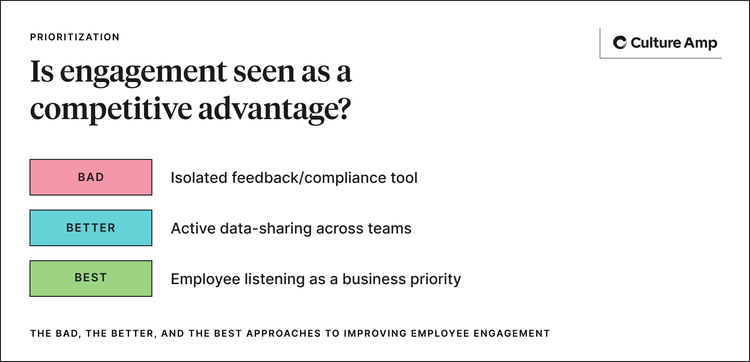
Bad: Employee listening is primarily an isolated compliance or feedback tool, highly protected by the team administering it.
Better: Data from employee listening initiatives is shared with other analytics teams, but connections between metrics may not yet be fully established.
Best: Employee listening data is recognized as central to business operations and is used to drive commercial and operational metrics.
People science tip: Build relationships with C-suite and other key decision-makers, and identify how employee listening data contributes to their key metrics. Whether it’s attrition, performance, or revenue, there is nothing more powerful than connecting employee experience to other KPIs.
A strong listening program starts with the survey itself. Poorly designed questions yield inaccurate insight, and survey design is more complex than most people think.
Robust survey design requires rigorous question development, adherence to best practices (e.g., reducing social desirability bias), and strategic customization for business relevance. Survey questions need to cover multiple aspects of work to create a holistic picture of the employee experience.
Additionally, to ensure clear results interpretation, survey items must be unambiguous. For example, when measuring perspectives on leadership, it’s critical to define who is referenced by the term “leadership.” Does it include managers? Directors? C-suite members? Well-constructed surveys minimize employee cognitive load and clarify results interpretation.
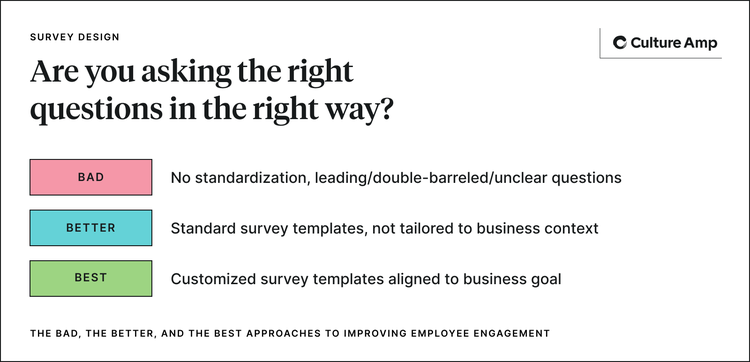
Bad: Leading, double-barreled, or unclear questions that don’t cover the full spectrum of employee experience. Questions change from survey to survey, making it difficult to track improvements. Items are not clearly organized around factors, and survey items that should be drivers are included as outcomes instead, muddying the organization’s ability to interpret the results.
Better: Survey templates are used to ensure that items capture the full employee experience, but questions aren’t always well adapted to the organizational context. The same questions are tracked in every survey, so improvements can be measured, but no new questions are added to capture the evolving business context.
Best: Questions are designed using survey templates that have been strategically customized to align with business goals while also leveraging best practice approaches to support survey design.
People science tip: When reviewing a draft of survey items, play the “What if?” game and consider what your next steps would be if certain items were deemed to be focus areas. This helps identify and correct any ambiguous interpretations before collecting survey data.

Check out our article for 11 tips on writing good survey questions.
High employee participation makes it more likely that an engagement survey will reflect the organization's diverse experiences. Achieving a good response rate from diverse employee groups requires targeted communication, thoughtful outreach, and consistent efforts to address participation barriers.
Strong participation is critical; without it, results may be skewed, missing key voices, and sacrificing actionability. Surveys with very low response rates will often raise more questions than they can answer, and we need to avoid this headache at all costs.
Ideal response rates will vary based on your company size, but aim for 65% as a minimum. Organizations benefit most from fostering ongoing engagement, encouraging year-round feedback to signal that employee perspectives drive real organizational change.
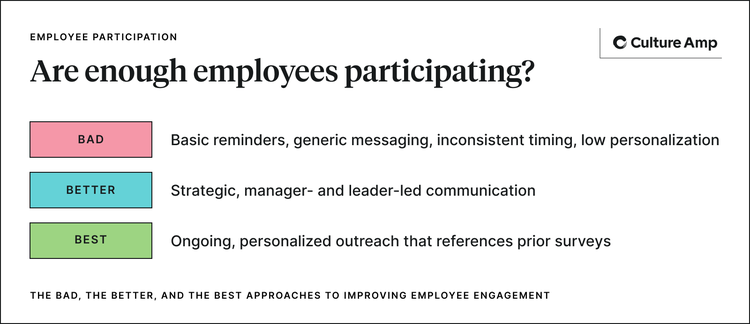
Bad: Uses basic reminders and generic messaging; the survey is promoted, but with inconsistent timing and without tailored tactics for target groups. Communications often overlook unique group participation needs by relying solely on specific channels without considering how front-line employees will receive the messages.
Better: Strategically plans communications, leverages managers and leaders through tailored messaging, and addresses barriers to improve participation and representativeness.
Best: Executes ongoing, data-informed engagement tactics, continuously optimizes outreach, personalizes by audience, and fosters a continuous feedback culture organization-wide. Includes reminders of past survey results and actions to foster trust in the process.
People science tip: If you have deskless employees, use SMS and/or QR codes to easily share the survey with employees who are not regularly using a computer during work hours.
Results analysis is often the most exciting part of the survey process for HR and leaders.
Engagement survey results are crucial for transforming raw data into actionable insights, identifying key drivers of employee sentiment, uncovering demographic trends, and pinpointing areas for improvement. Systematic interpretation allows organizations to make informed decisions, prioritize initiatives, and ultimately enhance both the employee experience and business outcomes.
A thorough analysis of the results is essential to uncover patterns and trends that may not be apparent at first glance. It’s important to approach this exercise with a hypothesis in mind. Before tackling analysis, always ask: “What do we expect to find?”
Not all insights will feel intuitive, which may sometimes result in overinterpretation or overfixation on patterns that are either very small or not meaningful enough to act on. Advanced data analysis techniques like regression analysis can help isolate true impact from noise.
Beyond providing objective results on patterns and trends within employee engagement, results analysis can also statistically link engagement to key organizational metrics, such as sales revenue and customer satisfaction. This helps determine how employee engagement and other factors influence critical business metrics.
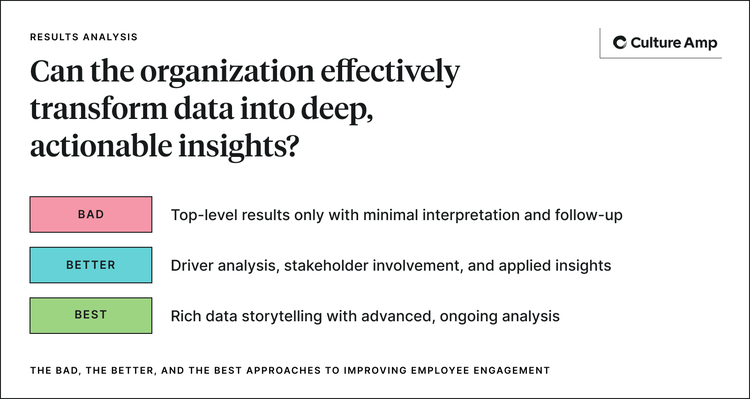
Bad: Reviews top-level results only, with minimal interpretation, follow-up, or action; lacks systematic analysis by demographics, context from trends and benchmarks, and connection to business priorities. Focuses primarily on the lowest-scoring items without consideration of their importance to the employee experience.
Better: Analyzes key drivers and trends, connects results to organizational goals, involves stakeholders, and applies insights for targeted action and impact tracking. Results are sliced and diced by demographics to determine differences in employee experience by demographic.
Best: Builds rich narratives that compel others to act. Practices advanced, ongoing data analysis; integrates statistical methods, business outcomes, and longitudinal insights; drives continuous learning, action, and strategy refinement.
People science tip: Plan data analysis strategy before launching a survey. Consider which areas of business are critical to you right now and how the data you collect can support these initiatives.
“Action” is a crucial area where many organizations fall short. But what good is listening if no action follows? As our CEO, Didier Elzinga, once said, “People don’t get survey fatigue; they get lack-of-action fatigue.” The true test of an employee listening program lies in the tangible changes and improvements driven by feedback.
The first step is to share results with employees. We recommend sharing high-level findings at the organizational level, such as in a company town hall. More detailed results, such as those within specific teams, can be presented by managers during a team meeting.
A helpful framework for how organizations choose to share and act on results includes "centralized action," which is action at the company level, "decentralized action" at the team level, or a combination of both. As people scientists, we most often see organizations use a combination approach: one overarching company action, with individual teams selecting one or two actions themselves.
As a general framework:
Centralized action alone is best suited for small organizations or those where survey results show that employees across the board have similar experiences.
Decentralized action alone is best for organizations where teams have very different experiences and focus areas.
The combination approach makes the most sense for organizations with very disparate teams but a central experience at the company level that could benefit from action.
After sharing the results, the next step is to share areas of focus and planned actions to address those areas. We suggest communicating along the lines of: "We heard X in the survey, so we are doing Y to address X." This helps employees see the action as directly connected to the feedback shared in the employee engagement survey. This is followed by the final step: taking true, meaningful action.
Effective action depends on two critical components: communication and real, noticeable change.
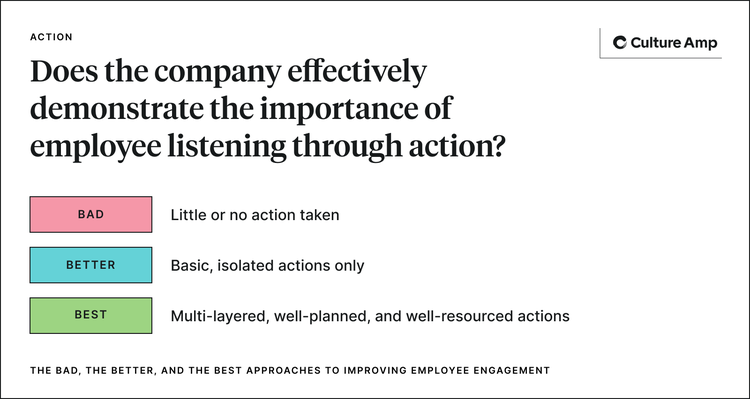
Bad: Little or no action is taken; results are shared superficially, with no follow-up or accountability. Actions are often limited or misplaced, or conversely, too many actions are identified without dedicating adequate time and resources to support them.
Better: Basic, isolated actions are implemented, often lacking consistency, alignment, or sustained impact tracking. There's a start to tracking engagement, but not yet a deep attention to action strategy and resources. Clear accountability is also lacking.
Best: Actions are multilayered, well-planned, adequately resourced, communicated, and tracked, focusing on engagement drivers. Continuous, data-driven action cycles, systematically measuring impact and driving sustained organizational learning. Employees are regularly updated on actions and progress toward goals.
People science tip: Identify action owners to increase accountability for strategic actions from engagement surveys. Taking effective action can be hard, so consider asking your employees for input, and acknowledge when the resulting outcomes don’t meet your expectations. You’re in this together!
Improving employee experience is a serious undertaking. It’s easy to feel like a failure when things don’t go as planned. Instead, accept that you won't achieve perfection immediately. Similar to fitness goals, incremental improvements from bad to better to best are not only possible, but essential for success.
Ready to get started? Identify your organization's position on the bad-to-better-to-best continuum, and ask yourself what’s hindering your progress. Review the five factors (competitive advantage, survey design, participation, results, and action) to determine your organization's current standing. Perhaps engagement initiatives are viewed as ”nice-to-haves” rather than strategic imperatives. Or, perhaps your organization struggles with asking the effective questions.
Once you've identified your organization's position, focus on implementing small changes to guide it in the right direction. Coach x Engage can help you understand what blockers may exist and how to overcome them. Coach x Engage is an AI tool built on people science within the Culture Amp platform. This powerful, science-backed tool can guide you in developing an impactful employee listening strategy, designing effective surveys, analyzing results, and taking meaningful action.
Here are some sample questions Coach x Engage can help you answer:
Our leaders believe that high engagement is optional. How can I convince them otherwise?
Is there any evidence that engagement drives performance?
Based on our focus areas and organizational goals, what items should we include in the next employee engagement survey?
Which questions in our survey have the highest risk of bias?
How can we increase employee participation in the survey?
Based on the survey results, which departments show the greatest increases in employee engagement?
What simple actions can our company take to improve employee engagement?
After you’ve gathered initial ideas from Coach x Engage, dig deeper with your people scientist. Share your ideas and plans for improving your listening strategy and ask, “Knowing what you know about our context and how we operate, what traps and pitfalls should we look out for?” Your people scientist can likely see what makes your organization unique: Maybe you’re a bit more hierarchical, have a lower risk tolerance, or you double down on transparency in your communications with employees. All these factors will impact what the “best” strategies look like for you. Your people scientist can offer additional research and resources to support your path forward.
Enhancing employee engagement requires organizations to embark on a strategic, data-driven journey. It’s not about isolated surveys or superficial fixes, but intentional design, active participation, insightful analysis, and consistent, well-planned action. By embracing the five factors we’ve shared above, you can diagnose what capabilities your organization may need to enhance to drive meaningful business impact.


Unlock the 47% advantage: A guide for modern leaders.
Article
Article
Article