Your workplace “heroes” won’t save you: What sustainable high performance really looks like
Written by

The employee experience platform
In this blog
Who are the heroes in your organization? If you’re picturing a small group of exceptional individuals who consistently step in to solve problems, bridge gaps, and carry others across the finish line, that culture of heroism could be holding your organization back.
Leadership may view these heroic acts as signs of organizational strength, but it isn't strength. It's structural fragility behind a high-performance mask.
At Culture First Forum North America, Justin Angsuwat, Chief People & Customer Engagement Officer at Culture Amp, put a name to something most people leaders quietly recognize but rarely say out loud: "Our best people, our heroes, are actually a warning sign because they can be a single point of dependency. We don't notice it, because it usually works… until the day it doesn't."
That observation cuts to the heart of one of the most persistent and costly myths in people strategy: that exceptional individual performance equates to organizational health.
What hero culture actually signals
Hero employees rarely look like liabilities. They hold deep institutional knowledge and context that lives nowhere else. They use this expertise not only to do stellar work, but also to catch problems before they surface. They make the organization look good, as if it’s capable of handling anything.
That's precisely the problem.
When the same people keep saving the day, leaders tend to read it as evidence of talent. What it actually signals is that the organizational culture depends on individual grit to compensate for structural failures – unclear ownership, weak handoffs, inconsistent management, and missing feedback loops.
The structural costs are predictable:
- Burnout accelerates as a handful of people carry the weight of broken systems.
- Knowledge concentrates in dangerous silos, creating key-person dependency at scale.
- Managers become bottlenecks instead of developing the leadership capacity of those around them.
- Performance becomes contingent on who is available, not on how the work is designed.
The data that reframes everything
Justin's session was grounded in Culture Amp's people science research, and one finding in particular reframes how HR and people leaders should think about performance strategy.
Only 10% of employees receive a high performance rating in any given year. Over a three-year period, just 5% achieve that rating twice.
Hiring more high performers won’t solve this, because it's not a pipeline problem. It's a systems problem.
High performance isn’t an identity, Justin explains, “It's a state. And because it's a state, it's cyclical, and the environment and culture play a huge role in creating that."
The implications for HR strategy are significant. If high performance is a state – one that can be created, supported, and sustained – then the mandate shifts entirely. The question stops being “Who are our best people?” and becomes “What conditions produce our best people?”
The Chicago Bulls’ framework for scalable performance
To emphasize his point, Justin used a basketball analogy: In the 1980s, when Michael Jordan played for the Chicago Bulls, he was the leading scorer in the NBA. The team prioritized getting the ball to Jordan, and that plan took them all the way to the finals, which they lost because the Detroit Pistons focused all their attention on keeping the ball away from Jordan. When the Bulls’ organization learned from their mistake and built an intentional system around Jordan rather than relying on his individual talent, the team became functionally unstoppable.
The same principle applies to teams and organizations outside of professional sports. Strong systems don't put constant pressure on their top performers to perform at the highest level. They create the conditions for high performance to spread across the organization, reducing dependency, accelerating learning, and building the kind of resilience that doesn't collapse when one person takes a vacation.
Peak Performance culture: The intersection that matters
Amy Lavoie, VP of People Science at Culture Amp, spoke to the Culture First Forum crowd about what a Peak Performance culture actually requires.
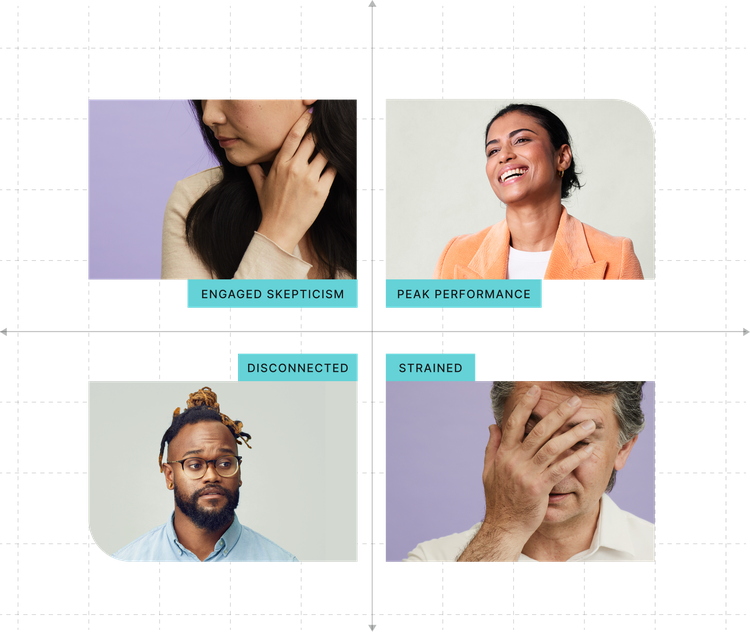
Peak Performance isn't about high output. It's the intersection of two specific conditions: workplace engagement and performance confidence. Amy explains:
"The winning formula is that when our employees feel engaged with both their organization and their work, and confident that the organization can succeed, we unlock that peak performance culture. These cultures have employees who want to be part of the company, who understand the strategy and what it takes to get there, who trust their leaders and teammates, and know they have what it takes to achieve success."
This distinction matters enormously for HR and people strategy. A team can produce strong short-term results through sheer force of will and hero-driven execution. But if the rest of the culture is weak – if people don't understand the path forward, feel the weight of structural ambiguity, or lack confidence in leadership – that output will erode. The heroes are likely to burn out first, followed by high attrition.
What this means for HR and people leaders right now
The actionable takeaway from the Culture First Forum isn't to stop valuing your top performers. It's to stop designing systems that require them to save the day again and again.
To shift a company’s culture from hero dependency to sustainable high performance, Culture Amp encourages people leaders to make four structural moves:
- Establish explicit ownership. Clarify roles and decision-making processes, so success doesn't depend on whoever has the most historical context or the loudest voice.
- Audit escalation patterns. When the same people are pulled in to fix problems over and over, that's not a talent signal – it's a structural one. Frequent rescue missions point directly to fuzzy priorities, weak cross-functional handoffs, or missing feedback loops.
- Look out for team strain. Listen to your employees to catch early signs of misalignment and overload before they compound into costly attrition.
- Embed continuous feedback. Structured 1-on-1s and consistent manager feedback create the conditions for learning to decentralize, reducing dependence on high-performing heroes and building the kind of distributed capability that scales.
The Culture Operating System question
Underlying all of this is a more fundamental question for organizational leaders: Are you running a CultureOS, or are you relying on exceptional individuals who have learned to compensate for the gaps in your culture?
Sustainable high performance comes from the system built around the work – from how clearly people understand what matters, how confident they feel in the organization's direction, and how effectively the environment equips all employees to perform at a high level.
Hero employees will always be vital to a company’s success. But if your strategy requires the same people to manage every priority, bridge every gap, and absorb every operational pressure, you may ultimately pay the price.
Instead of cheering even louder for your heroes, build a better system around them.

Make Culture as your operating system
Discover what high-growth organizations do differently to stay aligned, adaptable, and resilient during times of change.

Unlock the 47% advantage: A guide for modern leaders.