


Article
How, when, and why to run an employee benefits survey
Employee engagement
13 min read
Today’s leaders are being tasked with the near-impossible: Build a high-performance culture with a lean budget and fewer resources.
In these situations, your instincts may tell you to lean on your top performers and hope you can find the right incentives to keep them on the team. That might even work…for a while. But the reality is, building plans around a few hero employees is not sustainable; consistent organizational success is difficult to achieve with only a few standout performers.
When the market shifts overnight, budgets and strategies change abruptly, and even heroes can’t keep up. Burnout happens. Engagement drops. Turnover rises.
What organizations need isn’t a hero who can do it all, but a culture system that doesn’t rely on individual heroes. A culture system built on powerful values that get employees excited and motivated to come to work every day, where engaged teams succeed together and create a state of high performance that companies can maintain year after year.
That’s what Peak Performance is all about.
Culture Amp’s new Performance Culture Quadrant connects employee engagement and performance confidence to help companies identify their performance culture. Once you know where you stand, the Performance Culture Quadrant offers guidance on how your organization can develop a consistent culture of Peak Performance.
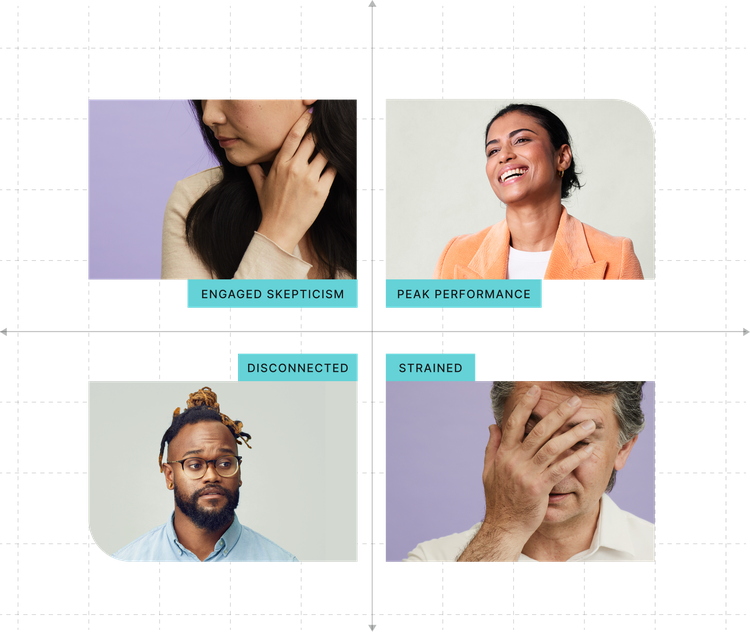
Looking at the Performance Culture Quadrant, you’ll see that Peak Performance sits in the top right corner, where high engagement and high performance confidence meet. In organizations experiencing Peak Performance, employees and teams are excited to work at the company, and they’re fully bought into its vision and strategy. When employees believe the company can win, their own performance lifts as a result.
We leveraged insights from across benchmark data studies, prospective studies, product impact
research, and a literature review spanning 50+ years of academic research to develop the diagnostic factors that underpin our new dual-outcome model.
When we tied employee engagement and performance confidence data together, we found six factors that leaders can use to drive change and achieve a Peak Performance culture:
To achieve excellence, Peak Performance organizations make “better every day” part of their cultural DNA. It may sound like a high bar, but Peak cultures are what they are because employees and leaders alike bring their A-game and do their highest-quality work.
According to Culture Amp research, employees are more engaged when working under a high-performing leader. But the reverse is also true: Underperforming leaders are three times more likely to have underperforming employees on their team.
Managers play a key role in promoting excellence and setting the tone for how work feels each day. They deliver feedback, determine workload distribution, ensure their team members feel seen and supported, and oversee performance management. Hiring great managers is worth your time and effort, because the right person can genuinely raise the level of the team.
Your company’s strategic North Star gives everyone a clear sense of its long-term goals and the values that will guide the way. In Peak cultures, people understand the "why" behind the overall strategy and focus on progressing toward that shared destination.
Culture Amp found that as company size increases, leaders score lower on their ability to communicate a motivating vision. As your company grows, consider how technology can support internal communication and collective organizational success. For example, you can use goal tracking software and data to show employees the direct impact they’re having on the business.
Taking ownership in Peak cultures means leaders have clear decision-making power and the autonomy to actually lead. A Peak organizational structure favors agility over micromanagement, such that everyone takes personal pride in the final result.
Likewise, giving employees more ownership over their work is key to sustaining performance. Decision-making frameworks (including DACI, RACI, RAPID, and more) bring structure to this process. Clarifying ownership and responsibility strengthens accountability, builds trust, and inspires people to invest more fully in their roles.
Culture Amp research shows that employees are 46 percentage points more engaged when they can develop skills that are relevant to their interests. This is why Peak cultures create ongoing opportunities for employees to learn and grow.
These organizations treat experimentation and even "smart failure" as essential tools for growth. Their culture fuels a constant cycle of development through honest, high-quality feedback and a commitment to promoting talent from within.
Peak culture employees know they can speak up or take a risk without being shut down, which is important since engagement and feeling heard go hand in hand. Culture Amp’s research with Inc. 5000 companies shows that open, honest two-way communication is one of the top factors that predict three-year revenue growth – the fastest-growing companies excel at making sure employees feel heard.
Peak Performance environments fuel two-way communication in a way that ensures the best ideas rise to the surface and risk is mitigated early.
Peak organizations align roles with what actually motivates people, and teams set aside time for high-performing employees to recharge. This can look like encouraging leaders to role-model healthy energy output (i.e., pacing their work, protecting recharging time) and strategically rotating high-intensity roles on their teams to avoid burnout and maintain sustained high performance over time.
By focusing on these six factors, organizations can create a sustainable, successful culture that keeps their employees and teams continuously motivated, inspired, and engaged.
By measuring these six factors and how they influence workplace engagement and performance confidence, the Performance Culture Quadrant shows where your culture is helping – or holding back – high performance. In turn, this helps you build the right culture operating system to achieve and sustain Peak Performance.
Whether you need to sharpen your vision, improve recognition practices, clarify decision-making, or recharge your team’s energy, uncovering and then fine-tuning these organizational success factors ensures your cultural system is intentionally designed to drive your strategy and your business forward.


Unlock the 47% advantage: A guide for modern leaders.
Article
Article
Article