
Article
Employee attrition: What it is and how to calculate it
Employee engagement
9 min read

Written by

Writer, Culture Amp
Ask five companies to describe their culture, and you’ll get five different answers. That’s to be expected – there’s no single culture that’s right for every company.
What a great culture looks like varies from organization to organization, but some organizations clearly have better cultures than others. So, what ultimately separates strong cultures from struggling ones? It comes down to the norms, behaviors, and everyday decisions that support people in doing good work.
This is where company culture examples can be helpful. Rather than chasing one ideal culture that may not be right for your company, looking at real-world examples gives you a clearer picture of what works (and what gets in the way).
Let’s take a look at what company culture really means, why it matters, and five patterns you can use to describe (and build) a better one within your organization.
Company culture is what actually happens day to day (such as how meetings are run, how feedback is handled, and how people are treated) – not what's written on a values page.
Positive company cultures make employees four times more likely to stay, and companies with strong performance cultures have seen stock price gains of up to 21% in a single year.
There's no single model for a great culture, but five recognizable patterns (feedback-rich, learning, recognition, change-responsive, and leadership-aligned) can help you describe and build a stronger one in your organization.
Company culture is the mix of shared values, norms, and everyday behaviors that shape how work actually happens in a company. It’s not a mission statement or a slide in an onboarding deck. It’s what leaders model, how decisions are made, how people are treated, and what gets rewarded (or tolerated).
Company culture is often lumped in with employee engagement, but the two aren’t the same thing. Think of engagement more like a report card – it tells you how people are experiencing your culture, based on survey scores and feedback. But culture is what they’re actually experiencing in the workplace.
For that reason, you likely won’t find the most reliable example of company culture on a careers page or a values poster. It’s more often found in the details of the daily work, including:
How meetings are run
How leaders communicate
How feedback is handled
How recognition works
How priorities are set
How people are supported through change
Are meetings run efficiently, or do they clog up everyone’s calendar and waste their time? Is feedback frequent and specific or saved for annual reviews? Is recognition tied to real outcomes or little more than an afterthought? These seemingly small, repeated patterns are what make up your culture – not your perks and posters.
Culture touches everything within a company, from how comfortable people feel suggesting an idea in a meeting to whether a high-performing employee takes a call from a recruiter.
But when you drill down to what matters most, culture affects three things that leaders care about: whether people stay, how the business performs, and how quickly people grow into what the business needs. Recent research backs up all three:
Retention: SHRM’s State of Global Workplace Culture research found that workers in a positive organizational culture are almost four times more likely to stay with their current employer. Just 15% of employees who rate their culture as good or excellent are actively job hunting, compared to 57% of those who rate their culture poorly.
Business performance: This is another area where companies with great culture stand out. In Culture Amp’s performance culture research, we use a two-by-two framework to group organizations by workplace engagement and performance confidence. In that research, public companies in the Peak Performance culture state saw a median 36% stock price increase over two years, compared with a median 11% decline for companies in other culture states.
Employee growth: A strong culture does more than make people want to stay – it makes sure they have room to grow. This matters, because growth has a significant impact on retention. Culture Amp data shows that employees without access to meaningful growth opportunities are twice as likely to leave within a year. It’s why development shows up again and again in real-world examples of good company culture.
None of this happens by accident. The companies that succeed in retention, performance, and growth are also the ones treating culture like a core business priority – not a side HR initiative.
There’s no single blueprint. A nonprofit, a retailer, a logistics company, and a software business can all have healthy cultures that look nothing alike. This is because they have different paces, priorities, and ways of working.
When people search for organizational company culture examples, they’re usually looking for a shortcut. Copy this company, get this result. But that shortcut doesn’t exist.
What does exist are markers of cultural health that show up across every kind of organization, regardless of industry or size. A great company culture is one that supports people to do good work in a way that’s sustainable, inclusive, and aligned with the company’s goals.
If you’re trying to figure out how to describe your company culture, look for examples of what’s working – and what’s not – in your own organization. The examples in the chart below may not be part of your values statement. Instead, you’ll find them in how work actually runs day to day.
| Healthy culture | Unhealthy culture |
|---|---|
| Trust | Fear-based leadership |
| Clarity | Hidden information |
| Fairness | Micromanagement |
| Inclusion | Burnout |
| Learning | Blame |
| Sustainable performance | High turnover |
Gathering real-world inspiration from other companies can help you define your own culture. Here, we’ve listed recognizable patterns associated with positive company cultures, but keep in mind that these aren’t intended as a checklist to follow. No company fits neatly into just one of these.
Think of the following categories as a useful way to understand and describe what happens in the daily work within your company, rather than rigid examples of corporate culture in business that you need to copy exactly. Chances are, your organization already shows traces of more than one.
As the name implies, a feedback-rich culture is one where feedback is normal and expected – not something that’s saved for a single conversation each year. Managers and peers share feedback regularly, and mistakes are discussed openly instead of buried.
Real-world example: Before 2020, shoe and accessories retailer Steve Madden had no formal way to hear from employees at scale. That changed when the company started surveying employees regularly, and the first results highlighted something leadership hadn’t noticed: People felt disconnected from their divisional leaders, even though they rated the CEO’s own communication highly.
Instead of letting that information sit in a report, the company acted on it by rolling out regular learning sessions. Today, 82% of employees say they’re proud to work there, and 87% feel like part of a team.
In a learning culture, employees are actively encouraged to set growth goals and build new skills. Managers make space for real development conversations instead of leaving them for once-a-year reviews.
Real-world example: Some of MLB’s employees had been with the league for over a decade, and annual reviews just weren’t cutting it. The process was exhausting for managers and failed to provide long-tenured staff with the development support they deserved.
So, the league shifted to a model built on regular 1-on-1s and in-the-moment feedback. What started as a listening exercise ended up changing MLB’s entire learning and development strategy, leading to new mentorship and leadership programs built directly from what employees said they needed.
MLB shows what business culture examples built around growth actually look like – not a line item in the budget for training, but a system that finds what people need and then acts on it.
Recognition works best when it’s specific and frequent, not just a pat on the back at the end of the year. In a recognition culture, people hear when they’ve done something well, and it’s usually tied to a value or behavior the company cares about (not just an outcome).
Real-world example: Pampered Chef wanted a way to make recognition visible and easy, so the company rolled out Culture Amp’s Shoutouts in a company-wide Slack channel, tagging each shoutout with custom emojis tied to their culture pillars.
In the three months that followed, employee recognition went from about 50 submissions (using their own tool) to 188 shoutouts, and scores on “I receive appropriate recognition for good work” rose 10 percentage points. It’s one of the more measurable examples of culture in a company, and it shows that recognition doesn’t have to rely on managers remembering to say something nice.
From reorgs to leadership shifts to market pressures, change is inevitable. What separates a change-responsive culture isn’t avoiding that disruption, but how leaders communicate through it: clearly, honestly, and with visible follow-through on what they hear.
Real-world example: When Australian rewards program Flybuys underwent a major reorganization, leadership didn't wait for the dust to settle to check in with employees. They replaced their usual annual survey with three short check-ins over six months, built specifically to track how people were experiencing the change in real time.
The first round flagged a pretty major disconnect: 98% of senior leaders felt clear and confident about the new direction, but only 56% of team members felt the same way. Leadership responded immediately, rolling out communication training, restructuring monthly leadership meetings, and holding every leader (and not just HR) accountable for their team's numbers.
The impact showed up quickly. One team's sentiment score climbed from 22% to 60% in six months, and company-wide engagement grew from 59% to 76% over the course of the transformation.
A leadership-aligned culture doesn’t rely on one visionary or charismatic founder. Instead, senior leaders model the behaviors they expect from everyone else. That alignment holds strong, even as the company grows past the size where informal culture usually starts to crack.
Real-world example: Most companies add layers as they reach 1,000 employees – more approvals, more processes, and more oversight to keep things from slipping – but as footwear and apparel brand On grew toward that number, they took the opposite approach. On's leadership made a deliberate choice to hand over more control to teams.
For this to work, employees needed to trust each other enough to speak up when something went wrong. So, leaders modeled this behavior. The CEO and CPO focused on giving each other direct, sometimes uncomfortable feedback in front of the rest of the leadership team, rather than saving it for private conversations. When employees saw their own leaders communicating this way in the open, they felt more comfortable being direct with each other.
The five patterns above describe culture in general terms. But performance culture is a more specific lens. It's the combination of how engaged people are in their work and how confident they feel in the company's ability to succeed. Culture Amp uses a two-by-two framework that groups organizations along those two dimensions.
This isn't the only way to categorize culture. It's simply another way of looking at it, built from years of engagement and performance research. The framework sorts organizations into four broad states:
Peak Performance: High energy, high confidence. People feel engaged in their work and believe in where the company is headed.
Engaged Skepticism: High energy, lower confidence. People care about the work but question whether leadership has the right plan to pull it off.
Strained: Lower energy, higher confidence. The company may be hitting its targets, but the pace is coming at a human cost.
Disconnected: Lower energy, lower confidence. People feel unclear on priorities and are unconvinced the organization is set up to succeed.
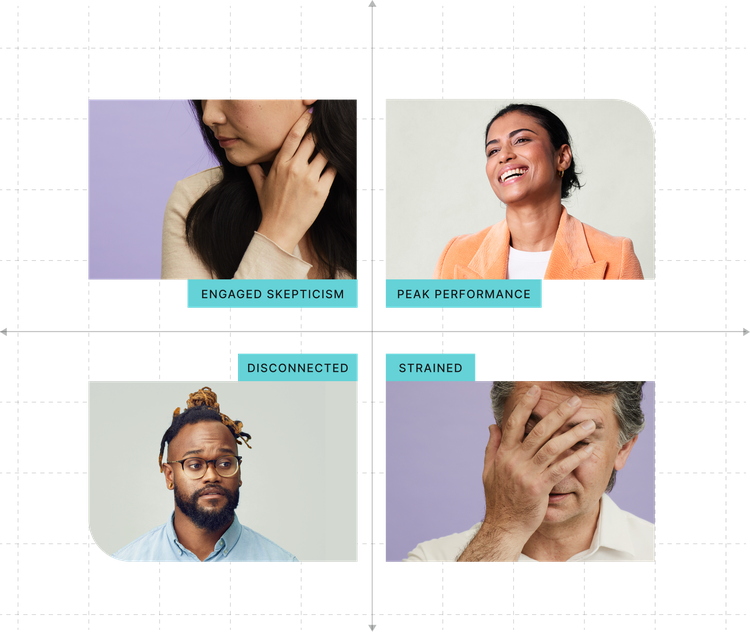
No framework can accurately diagnose a company's culture from the outside. These are broad patterns, not labels to be assigned. But they're a useful way to think about company culture examples through the lens of performance, alongside the five patterns above.
Whether you're looking at the best company culture examples across industries or trying to name what's happening in your own organization, understanding both lenses – general culture patterns and performance-specific ones – gives you a fuller picture of what's actually going on and where to focus.
These patterns aren’t necessarily complicated, but they also don’t happen on their own. Feedback needs a system to make it routine. Growth needs real conversations. Recognition needs to happen often enough that it means something. And in times of change, people need leaders who really listen.
Culture Amp helps you put all of that into practice, with tools built around each of the patterns above:
Engage surveys give you an honest read on what’s actually happening in your organization.
Goals make culture visible through clarity and alignment around priorities.
Develop supports a culture of continuous feedback, growth, and learning.
Shoutouts turn recognition into a regular habit.
Skills Coach and AI Coach support culture change by helping managers and employees become more effective at giving feedback, coaching direct reports, and having tough conversations.
And if you want a deeper read on your organization's performance culture specifically, our Performance Culture Quadrant can help you see where you stand and identify how to move toward, or stay in, Peak Performance.
At the end of the day, no single culture is right for every company. But there is a right question to keep asking: What does your organization actually model, reward, and tolerate? Answer honestly, and you’re already on track to build a better culture than the one you started with.
Yes. Most healthy organizations show traces of several patterns at once. For example, a company can be both feedback-rich and recognition-focused. The patterns aren't mutually exclusive. They're different lenses for describing behaviors that often overlap.
No. Values are what a company says it believes in, usually written down somewhere. Culture is what actually happens day to day, regardless of what's on the wall. A company can have strong values on paper and a weak culture if leaders don't consistently model them.
Yes, and it often does. Larger organizations frequently develop subcultures as teams grow or operate with different leaders, especially during periods of rapid growth or reorganization. This is common and not necessarily a red flag, but it's worth watching for cases where subcultures pull people in conflicting directions.
Start by listening. Most culture problems can't be fixed until leadership goes beyond assumptions to understand how people are actually experiencing work. An employee engagement survey is usually the fastest way to get that clarity before deciding where to focus.

Unlock the 47% advantage: A guide for modern leaders.
Article
Article
Article