
Article
Employee attrition: What it is and how to calculate it
Employee engagement
9 min read
Written by

Writer, Culture Amp
The 9-box grid (also known as the 9-box matrix) is a widely used talent management tool. It involves plotting employees on a simple grid to visualize their performance and potential, so leaders can get a shared understanding of how people are doing today and who might be considered for future roles.
The 9-box grid can be useful, but it’s far from perfect. When you have clear expectations and solid evidence, performance is easier to define and discuss. But potential is much tougher to define and assess consistently. And when you ask a room full of managers to rate an ambiguous construct without shared criteria, bias can enter the process.
In this guide, we’ll cover what the 9-box grid is, how organizations use it, and where it tends to fall short. We’ll also share a way you can stick with this easy-to-use structure, while improving it with a few helpful tweaks.
The 9-box grid is a widely used talent management tool that plots employees based on their performance and potential. It’s used to guide development, promotion, and succession decisions.
Performance is relatively easy to define and calibrate, but potential is harder to define and assess consistently, which makes the traditional grid less useful.
Swapping potential for something that’s narrower and easier to observe (like readiness) keeps the simple 9-box structure while reducing the ambiguity.
A 9-box model plots employees across two areas: performance on one axis, potential on the other. Here are the 9-box definitions for each of those dimensions:
Performance: An assessment of how well someone is doing in their current role (results, behaviors, and how their work compares to expectations)
Potential: A forward-looking judgment about whether someone may be able to contribute in a larger, more complex, or more senior role
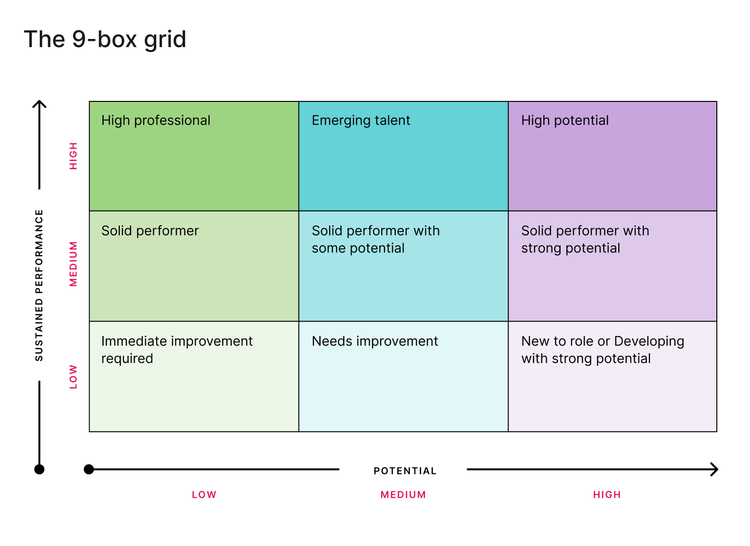
The resulting grid has nine boxes where an employee can be placed, ranging from “immediate improvement required” to “high potential.” Here’s what it looks like:
Most organizations use a 9-box grid talent-mapping exercise for one of the following reasons:
Running talent reviews: Managers and HR teams sit down together and plot each person on the grid based on their current performance and perceived potential, usually as part of an annual or biannual review cycle. This is often done as a group so leaders can compare notes across teams.
Planning development: Once people are placed on the grid, HR teams look for patterns worth taking action on. For example, they may identify a group of strong performers who are ready for stretch assignments or people who might benefit from more structured coaching.
Kicking off succession planning: Some organizations use a 9-box grid succession planning process as one input for determining who could step into a more senior or specialized role if the need arises. The grid can also give them a better idea of where they might need to hire externally.
In any of those use cases, the benefit of a 9-box matrix talent-management exercise is that it provides leaders a shared reference point for discussing where people currently stand (and where they could go next).
Each axis of the grid uses an intuitive low, medium, high scale. Potential runs along the bottom, and performance runs up the side. Where someone lands depends on how they score in both areas.
This gives you nine possible combinations, with each box representing a different mix of the performance and potential. For example, you could have someone who’s performing well today but doesn’t have much room to grow (High performer x Low potential), or someone newer who’s showing a lot of promise (Medium performer x High potential).
Here’s a quick look at how the process generally works using the traditional grid:
Define the performance scale: Decide what counts as low, medium, and high performance in a given role. This should be linked to concrete criteria like performance ratings (instead of relying on a manager’s gut feel).
Define the potential scale: Do the same for potential, but be careful about treating a broad judgment as a dependable score. If you do use potential as an axis on your grid, our people scientists recommend defining it through a structured, validated framework and training managers to apply it consistently.
Plot each person: Managers (often as a group) consider where each employee belongs on both dimensions and place them in that box, which becomes their 9-box rating.
Interpret the results: From there, teams use those placements to guide their development conversations, promotion decisions, or succession plans.
The grid itself isn’t all that tricky. The challenging part is making sure you’re inputting reliable ratings that are grounded in evidence and applied consistently (especially on the “potential” side).
So, what is the 9-box grid actually good at, and where does it fall short? Like most talent tools, there’s a mix of pros and cons to be aware of.
Provides an easy-to-read visual: Executives and senior leaders are busy, which means they often want to see complex people data at a glance. The 9-box grid gives a single, clear picture.
Creates a shared standard: Before using the grid to evaluate employees, confirm that leadership and managers agree on what counts as high, medium, and low performance. This sets them up to have valuable conversations and helps calibrate expectations across teams.
Supports internal mobility: Filling a senior role internally is usually cheaper and faster than hiring externally. The grid can help identify people who are worth investing in instead of looking outside the company.
Struggles to rate potential reliably: There isn’t a universally accepted way to define and measure someone’s future potential. This doesn’t mean potential can never be assessed. But it does mean organizations should be cautious about treating a manager’s informal judgment as a dependable measure. One recent study of an international professional services firm found that promoted employees performed worse on average after explicit potential ratings were introduced.
Opens the door to bias: Potential is subjective, so attempting to rate it creates opportunities for bias and favoritism. Even if it happens unconsciously, managers tend to favor people who remind them of themselves or fit their idea of what a leader “looks” like. Case in point: One study found that women were 28% less likely than men to receive the highest potential rating, despite receiving higher performance ratings. Differences in potential ratings explained up to around half of the observed gender promotion gap.
Sticks lasting labels on people: A 9-box evaluation tool quite literally puts people in a box. Once they’re there, it’s easy for that label to follow them and influence how they’re seen moving forward (even if it no longer fits).
It’s easy to see why the 9-box grid remains one of the most common talent-assessment tools out there. It’s simple and familiar. Yet, we don’t recommend using the traditional performance-versus-potential 9-box as your default approach to evaluating employees for promotion, succession, or development.
Performance is comparatively easy to define and measure, but potential isn’t (unless you’re using a validated framework). Pairing a defined metric with an undefined one (and treating both with equal confidence) can lead to a lot of different problems.
We’re not suggesting that you skip talent reviews or succession planning. Both are important talent management processes. But there’s a better way to run them than defaulting to the traditional version of this grid.
Fortunately, if you like the ease of the two-dimensional approach, you don’t need to do away with it entirely. You just need a better second axis.
If you’re locked into using a 9-box grid, the biggest improvement you can make is to swap “potential” with a quality that’s narrower and easier to observe. For example, readiness.
Potential asks, “Could this person grow into a bigger role someday?” Readiness gets more specific and asks, “Is this person prepared for a particular next role within a defined timeframe?” That’s easier for managers to actually assess and agree on since it’s tied to concrete criteria rather than guesswork.
Here are a few ways to make readiness assessments work as part of your broader 9-box performance management process:
Define what “ready” means for each role in advance
Base the rating on skills, experience, and specific accomplishments
Calibrate as a group so that one manager’s read isn’t the deciding factor
Keep in mind that a clear definition is what makes readiness work here, so take the time to clarify what it actually looks like. There’s no point in swapping potential for something that’s equally ambiguous.
If you do include potential, apply the same discipline: Use a structured, validated framework, train managers on it before the review cycle, and calibrate the ratings rather than relying on a single manager’s judgment.
Switching potential for readiness fixes the biggest issue with the traditional 9-box grid for talent management. However, the grid is still just a tool that supports a bigger conversation. That conversation itself (and whether or not it leads to good decisions) matters far more than how you get there.
So, instead of asking which box to put a person in, try focusing on a different set of questions:
Is this rating tied to something concrete? If you can’t point to specific behaviors, projects, or outcomes behind a rating, it’s worth examining why.
What’s the actual next step for this person? It’s not helpful to give someone a rating without any direction about what to do next. Whether it’s a stretch project, a skill to build, or a conversation with a specific mentor, give your employees action steps, not just a label.
Is more than one person weighing in? Bringing in other voices (like peers and cross-functional partners) will give you a more well-rounded perspective.
Are certain groups consistently landing lower? If a pattern shows up across gender, race, tenure, or any other group, you’ll want to dig into that right away.
Ultimately, you want to focus on comparing the right variables and getting more than one perspective as you fill out the grid. That’s the idea behind Culture Amp’s Ratings Matrix in Calibration Views. You can use it to plot two variables (like performance and promotion readiness), and then pair it with structured calibration sessions to check those ratings. Ratings Preview can make that process even stronger by flagging questions and misalignment before your calibration meeting even starts.
All of this helps ensure that your talent conversations leave employees with a clear path forward, not just a box they’re stuck in.
While a 9-box matrix isn’t something Culture Amp recommends, some organizations may find it useful with a few tweaks. However, if you decide a grid format isn’t the right fit at all, here are a few other approaches to talent planning worth considering:
Grouping by future role: Identifying people who could grow into a category of similar future roles, rather than plotting everyone on a fixed grid.
Skills-based assessments: Rating people against specific competencies tied to future roles.
Structured career conversations: Switching to regular, criteria-based check-in conversations on readiness and growth.
The 9-box grid isn’t going anywhere soon. It’s simple, straightforward, and gives everyone a shared language for talking about talent, but that doesn’t mean it’s the best or only choice. If your organization still wants to use a 9-box style process, we recommend using a more defined second axis, such as promotion readiness, or a structured, validated “potential” framework if it already exists. And make time for calibration, bias checks, and clear development actions.
Culture Amp’s AI Coach can help your managers with that last part. AI Coach provides personalized, contextual, science-backed coaching and guidance to help people leaders make sense of people insights, navigate challenging conversations, prepare for performance and career discussions, and turn insights into tailored action plans and communications.
Because strong talent management doesn’t come from putting people in a box. It comes from thinking outside of it.
Yes, the 9-box grid is one of the most widely used talent management tools, mostly because it’s easy to understand. However, popularity doesn’t mean it’s the most effective option.
No. A performance review evaluates someone’s current work. A 9-box grid takes that performance rating and pairs it with a second rating (typically potential) to inform bigger-picture talent decisions, like promotions and succession planning.
Potential is about whether someone could grow into a bigger role someday. It’s broad and tough to verify. Readiness focuses on whether someone is prepared for a specific role within a defined timeframe, based on observable criteria. Readiness is easier to rate accurately, making it a better fit for this type of evaluation.
Our people scientists strongly recommend readiness, but other options include:
Cultural/value fit: How well the employee embodies your organization’s culture and values
Competency / mastery: The level of technical capability or core functional skills an employee demonstrates in their role
Will to succeed: The level of motivation and willpower an employee exhibits in executing on their day-to-day role and responsibilities
You should judge these alternatives in the context of your organization’s goals, priorities, and values.
No. The grid itself doesn't remove bias; it simply organizes ratings visually. Fairness comes from how those ratings are defined, who’s involved in calibrating them, and whether patterns are checked across groups.



Unlock the 47% advantage: A guide for modern leaders.
Article
Article
Article