
Article
How, when, and why to run an employee benefits survey
Employee engagement
13 min read

Written by

Writer, Culture Amp
Choosing the right employee experience platform for your organization isn’t just a technology decision. It’s a critical investment in how your people work, perform, and grow at your organization.
Employee experience encompasses every interaction employees have with your company throughout the employee lifecycle, from onboarding and development to performance conversations and exit experiences. When those experiences are positive, organizations see higher engagement, stronger productivity, better retention, and improved business outcomes.
In fact, Culture Amp found that, over two years, public companies in the Peak Performance state (when employee experience is positive and employees are excited to be at their organization) see a 47% stock price advantage.
That's why creating a thorough Request for Proposal (RFP) matters more than ever. In this guide, we share a template for evaluating employee experience platform vendors, along with sample questions that will help you find the right partner for building your Peak Performance culture.
An employee experience RFP helps organizations evaluate vendors based on business outcomes, people strategy, technology capabilities, security, and support.
Modern employee experience platforms should be assessed across eight core areas: people science, AI, employee listening, analytics, manager enablement, performance management, employee development, and integrations.
A structured RFP process reduces risk, strengthens due diligence, and increases the likelihood of selecting a platform that will improve engagement, retention, and organizational performance.
A Request for Proposal (RFP) is a formal document that organizations use to evaluate potential vendors for a product or service. An RFP serves three purposes:
It clearly defines your business, technical, product, and support requirements.
It asks vendors to explain how their solution meets those needs.
It provides a structured framework for evaluating platforms across business, technical, security, implementation, support, and product criteria.
An RFP allows your organization to specify your goals, desired business outcomes, technical requirements, and employee experience priorities before engaging vendors. Rather than evaluating platforms based solely on feature lists, a well-designed RFP helps you assess which solution is best positioned to support your people strategy and deliver measurable impact.
Depending on your timeline, decision-making process, and stakeholders involved, you might also leverage the following related documents to gather details and narrow your search:
RFI (Request for Information): Used to gather preliminary information about vendors and solutions
RFQ (Request for Quotation): Focused primarily on pricing
RFP (Request for Proposal): Evaluates overall fit, capabilities, and value
ITT (Invitation to Tender): A formal invitation for vendors to submit detailed bids
While these procurement tools all serve slightly different purposes and support different stages of the procurement process, the RFP is typically the most comprehensive measure used in vendor evaluation.
A structured RFP process helps organizations make more informed purchasing decisions while reducing implementation and vendor-selection risk. Here are the primary benefits of creating one:
More consistent comparisons. An RFP ensures every vendor responds to the same requirements and evaluation criteria. This gives you a more objective, apples-to-apples comparison process so you can make the best decision possible.
Better commercial outcomes. Inviting multiple vendors into a competitive process often improves pricing, service levels, and contract flexibility.
Stronger due diligence and lower risk. An RFP requires vendors to document how they address security, privacy, compliance, accessibility, and governance requirements before contracts are signed.
Better fit-to-need. An RFP helps organizations select a platform that’s based on business outcomes rather than flashy demonstrations or existing relationships. The right solution should align with your employee experience strategy, organizational goals, and long-term people priorities.
The best employee experience platforms go beyond surveys. Use our guide below to build an employee experience RFP that evaluates not just technology, but the science, methodologies, and capabilities needed to create a thriving workplace.
When it comes to employee experience technology, the science behind it matters. People science is the practice of understanding and shaping how people think, feel, behave, and learn. It exists at the intersection of behavioral psychology, organizational development, business analytics, data science, and more.
With people science embedded into a platform, HR teams can trust that surveys, benchmarks, recommendations, and insights are evidence-based rather than based on assumptions. This is why it’s important to look for vendors that treat people science as a core capability – not a marketing tagline.
Questions to ask potential vendors
Do you have an internal people science team that supports your customers?
Describe the services provided by data scientists as part of your platform offering.
Will we be assigned a people scientist? How often will they meet with us?
How does your data science team collaborate with HR teams to tailor analytics, develop custom reports, and support strategic decision-making?
Artificial intelligence is reshaping how organizations survey employees, analyze feedback, coach managers, and drive action.
Today's leading employee experience platforms don't simply offer AI as an add-on feature. Instead, they weave AI throughout the employee experience, helping leaders move faster from insight to action while maintaining trust, transparency, and responsible governance.
Questions to ask potential vendors
What is your company's perspective on AI?
Describe any AI-powered reporting features available in your platform.
Can you describe which features use AI models and how these enable users to achieve their goals more effectively?
Is AI-powered comment sentiment analysis available?
Do you offer AI-powered support and analysis for action planning?
Can AI be trained on our proprietary data?
What safeguards are in place to prevent AI bias?
What protocols prevent AI from exposing sensitive or confidential employee data?
How do you make AI outputs explainable and transparent?
Can administrators disable AI features if desired?
What other governance controls are available?
What is your AI roadmap over the next two years?
Listening is the foundation of the employee experience. Organizations need multiple ways to capture employee feedback across the entire employee lifecycle and not just during annual engagement surveys.
When you leverage platforms that support continuous listening, lifecycle surveys, pulse surveys, and action-oriented feedback programs, you’re better equipped to drive meaningful cultural change within your organization. For example, Avalere Health's Employee Net Promoter Score (eNPS) went up by 10% in 12 months using Culture Amp. More impressively, voluntary attrition dropped by half from 26% to 13%.
Questions to ask potential vendors
Do you offer pre-built, evidence-based survey templates?
How is the survey experience designed to be quick, intuitive, and easy to understand for the end-user?
How does your solution enable us to track trends across different iterations of our survey?
How does the platform support measurement across the employee lifecycle, including onboarding, leadership transitions, performance, change management, and exit?
Can participation rates be viewed in real time?
What communication support do you provide before, during, and after surveys?
Can survey communications be customized?
Can your platform send automated reminders to respondents to complete their surveys?
How do you identify and measure high-performing organizations?
How does your solution connect listening data to improved business outcomes?
Collecting data is only valuable if organizations can turn it into actionable insights and strategic decision-making. Modern employee experience platforms help leaders identify patterns, understand drivers of engagement, and prioritize actions that create meaningful change.
Furthermore, combining advanced analytics capabilities with AI enables HR teams to surface valuable insights themselves, which can shorten the time to action – an essential capability in business environments that are constantly shifting and advancing.
Questions to ask potential vendors
What are the standard reports available within your solution?
What dashboard customization options are available?
How can analytics be filtered by demographic, geographic, and organizational attributes?
Do you offer predictive analytics capabilities?
Can your platform identify retention risks?
Are benchmarking capabilities available?
How extensive and statistically valid is your benchmark dataset?
How do you identify the most impactful drivers of engagement?
Describe your sentiment analysis and text analytics capabilities.
Can data be exported for use in external BI or analytics tools?
How do you deliver targeted reports to different stakeholder groups?
What measures ensure confidentiality while providing meaningful insights?
Research consistently shows that managers influence engagement, retention, performance, and wellbeing. That's why it’s worth evaluating how different employee experience platforms help managers understand feedback and take meaningful action.
Additionally, look for a platform that provides leaders with the leadership coaching and just-in-time support they need to do great work and create long-lasting impact throughout your business.
Questions to ask potential vendors
What kind of action-planning capabilities does the platform provide?
How do managers and leaders create and manage action plans based on survey results or a performance review?
Is there functionality for HR and line managers to respond to comments during and after a survey round?
Are AI-powered coaching or action recommendations available?
How can HR and managers respond to employee feedback?
What level of visibility exists for action plans?
Can leaders track the progress of action plans across teams?
How do you increase visibility into actions being taken across the organization?
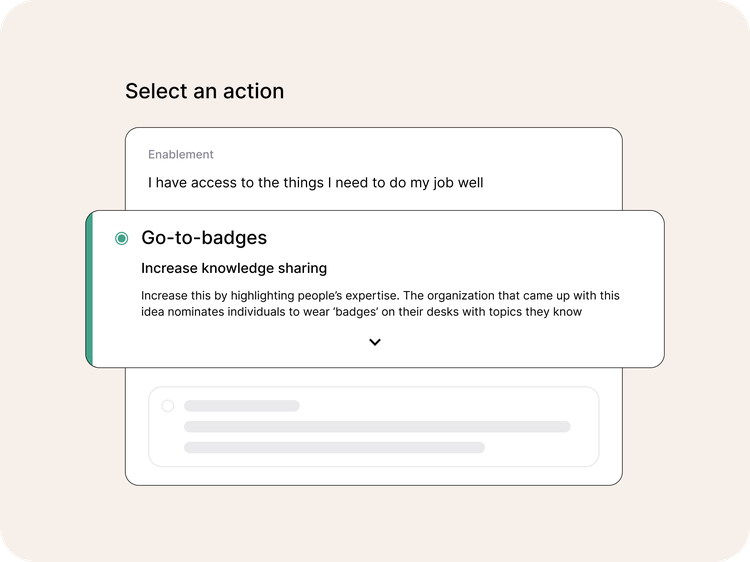
Organizations that separate engagement and performance often struggle to connect employee sentiment with business outcomes. Evaluating performance capabilities alongside listening capabilities helps create a more complete view of employee success.
This is because sustainable high performance comes from engagement and performance rising together. Companies that doubled down on these two levers saw more revenue growth – and that 47% stock price increase mentioned earlier in this article.
So, look for solutions that support continuous performance conversations, not just annual reviews.
Questions to ask potential vendors
Does your solution allow employees and managers to create, maintain, and align goals within the platform?
How does your approach to goal management support various goal frameworks (i.e., SMART, KPI, OKR, etc.)?
Does your solution have a shared collaborative space to support a 1-on-1 meeting format?
How does your platform enable employees to deliver clear, timely, and constructive feedback to others?
Does it support self, peer, manager, and upward performance evaluations?
Does it integrate with our existing tech stack and communication channels?
Can performance data be connected with engagement insights?
What bias reduction features are built into the performance features?
Do you offer a consolidated view for each user to centralize all of their performance measures/outputs across that platform?
How can your solution support talent planning initiatives using hard data points?
How does it foster a culture of continuous improvement?
Do you support 180-degree and 360-degree feedback processes?
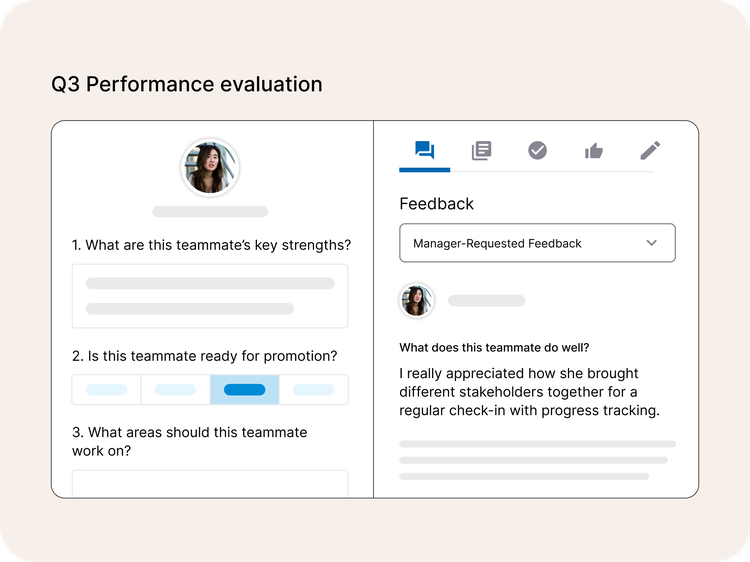
Employees increasingly expect opportunities to learn, grow, and advance their careers. It’s also an organizational advantage to develop your people: Culture Amp found that employees using personalized development plans see a 30% average performance rating increase.
As technology continues to advance and new skills are required to future-proof organizations, it’s more important than ever to evaluate how employee experience platforms support career growth, skill development, and capability building.
Questions to ask potential vendors
Does the platform offer personalized development plans?
How does it support employee growth and upskilling initiatives?
Are competency frameworks and career paths available?
Can competency frameworks and career paths be embedded into employee workflows?
How does development connect with performance and engagement data?
What analytics and reporting capabilities are available for development initiatives?
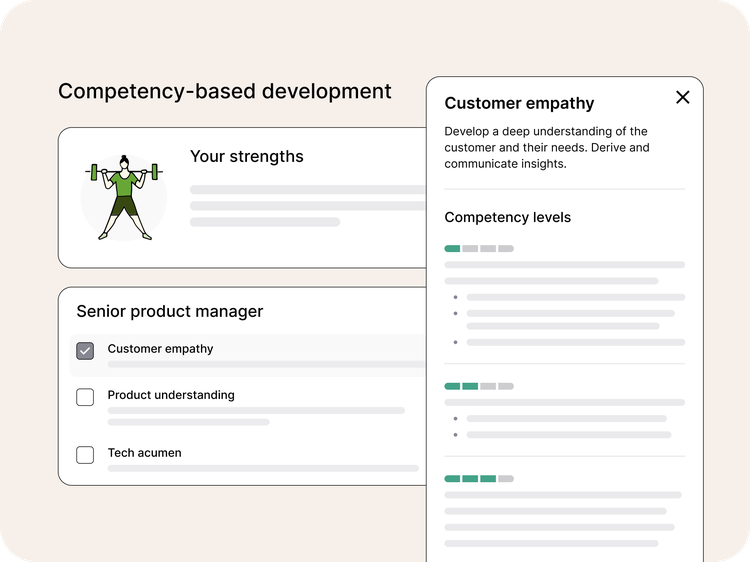
Even the most powerful employee experience platform won't deliver value if it exists in isolation. Strong integrations reduce administrative burden, improve data quality, and create a better user experience.
The ideal solution fits seamlessly into your technology ecosystem, connecting employee data, workflows, and experiences across systems.
Questions to ask potential vendors
Can your platform integrate with our HRIS?
How is employee data imported and synchronized?
Can the solution scale to accommodate a large number of users and account for growth?
Does the platform integrate with SSO and identity providers?
Does it support global organizations and complex organizational structures?
What accessibility and inclusion features are available for diverse, global workforces?
Describe your approach to supporting the entire employee lifecycle and integrations with HRIS/HR tech systems.
Describe your approach to implementation and the resources involved.
What implementation resources are included?
What technical support options are available?
What are your support hours and service-level commitments?
Is support provided by internal teams or outsourced?
Do you provide training resources and on-demand learning content?
Is there a customer community available?
What security certifications do you maintain (SOC 2, ISO 27001, etc.)?
How do you approach privacy, compliance, and data protection?
Finding the right employee experience platform for your organization is no small feat. A thoughtful RFP helps you evaluate vendors based on the outcomes that matter most to your business.
The more clearly you define your goals, success metrics, and business outcomes upfront, the more likely you are to find a solution that delivers lasting impact for your employees – and your organization.
An employee experience RFP (Request for Proposal) is a document organizations use to evaluate and compare employee experience software vendors based on business, technical, security, and support requirements.
An RFP creates a consistent evaluation process, reduces vendor-selection risk, and helps organizations choose a solution that aligns with their people and business goals.
Key sections should cover people science, AI capabilities, employee feedback and listening, analytics, performance management, employee development, integrations, and security.
AI can help analyze employee feedback, identify trends, provide coaching recommendations, support action planning, and accelerate decision-making while maintaining governance controls.
Organizations should ask about analytics, benchmarking, AI governance, survey capabilities, manager tools, integrations, security certifications, implementation resources, and ongoing customer support.

Unlock the 47% advantage: A guide for modern leaders.
Article
Article
Article