
Article
78 performance review phrases to share effective feedback
Performance management
18 min read
Written by

The employee experience platform
Walk into a manufacturing plant, and you’ll see the signs of modernization all around you, from robotic arms working alongside line operators to supervisors splitting their attention between throughput and tablets.
Today’s manufacturing leaders face the significant challenge of helping their teams evolve at the same pace as the machinery they operate. Production capacity depends on how your organization navigates uncertainty, so as your technology advances, reestablishing stability is critical to ensuring your plant runs optimally through the change.
Smart manufacturing is reshaping what employees on the plant floor need to know and do faster than most workforces can absorb. As a result, reaching, developing, and retaining the frontline workforce has become a strategic HR priority. Plant supervisors are the connective tissue between topline strategy and the plant floor, so they need the right tools to motivate and engage their teams.
In this report, we’ll explore three key challenges destabilizing the manufacturing workforce:
Reaching the deskless workforce on the plant floor
The changing of the guard as the most experienced workers retire
Leadership skill development for supervisors caught between technical promotion and the role smart manufacturing now demands.
Protecting production through these broader shifts requires HR listening tools that reach the plant floor and development infrastructure built for the people on it.
• Workforce stability determines production capacity in manufacturing, and engagement is the earliest signal.
• The plant floor is certain about its work, but less sure about company direction. Mobile-friendly listening is the channel that closes that gap.
• 23% of the manufacturing workforce holds a decade of institutional knowledge, and the cohort behind them is thinner, so the handoff window is critical.
• Three of the top four engagement drivers in manufacturing are leadership behaviors that sit with the supervisor, and technical promotion alone doesn’t build them.
• Action on survey results is manufacturing’s weakest factor against the global benchmark. Supervisors need structure, not more data, to close the loop.
Today, the average manufacturing plant can monitor throughput, temperature, and quality rates in real time, down to the station and the shift. Metrics abound in manufacturing. The hardest signal to pull from the plant floor isn’t coming from the machines, but from the people running them.
Frontline and deskless workers make up roughly 80% of the global workforce, according to BCG, and manufacturing’s plant floor sits squarely inside that majority. Most of these workers never see the email with the strategy update. They are not in the all-hands. Corporate information sometimes reaches supervisors, but it reaches the floor only when supervisors relay it.
The operating assumption for decades was straightforward: Frontline workers don’t need to understand macro strategy as long as they know their role and their daily quota. But when Culture Amp looks at our manufacturing benchmarks, we see that assumption has worn through.
The floor knows its job: 87.4% of manufacturing employees say they know how to be successful in their role, and nearly 9 in 10 know how their work contributes to company goals.
Ask about the company's direction, and the picture changes. 28% of the workforce is neutral, and another 14% is unfavorable on whether the company effectively directs resources toward its goals. 26% are unsure whether the company acts on promising new or innovative ideas.
This data suggests that the people on the floor are certain about their own tasks, but less so about where the company is headed.
That gap has consequences. We’ve found that two questions most directly shape engagement. whether those leaders have communicated a motivating vision, and whether employees have confidence in them. Both factors depend on strategic transparency reaching the floor. Without a channel for clear, two-way communication, those drivers stall. While the data doesn’t establish cause and effect, the pattern is consistent.
When workers aren’t connected to the company’s direction, discretionary effort is usually the first thing to dip. A line operator who doesn’t believe the company is heading somewhere worth following still shows up and runs the machine. However, the extra attention, the anomaly flagged before it becomes a defect, those signals start to disappear slowly enough that the cost surfaces in operations before anyone can name the cause.
Mobile-friendly listening is the channel the floor hasn’t had access to. Engagement surveys segmented by shift, plant, and tenure give HR a way to see where strategy is landing on the floor and where it has stalled. When employees have a platform to weigh in on strategic direction, they move from feeling like a cog in the machine to a valued partner in how the plant runs.
Reaching the floor is the first lever. The next is keeping the people on it.
On most plant floors, operators gain the expertise needed to manage line disruptions through hands-on observation. Years of pattern recognition, machine intuition, and supplier history live in their heads.
Workers 55+ now make up roughly a quarter of manufacturing employment, and Deloitte projects that by 2030, about half of the technical manufacturing workforce will be eligible to retire.
Culture Amp data shows that the largest employee group in manufacturing has been with the company for 10+ years (23%), while the second-largest group has been in-seat for 2-4 years (22%). The middle-tenured are hollowed out in comparison.
The knowledge carried by long-tenured employees rarely transfers to their replacements, and this changeover is happening at a scale that threatens to leave a major knowledge gap in its wake.
It shows on the floor first. For example, a veteran operator retires, and a process that ran for years without incident starts generating exceptions that the replacement can’t explain. The new operator follows the standard workflow, but the standard workflow never captured the judgment call.
Institutional knowledge only transfers through people who stay long enough to teach it. It moves from the experienced cohort to the incoming one only when both groups spend time on the floor together, with enough overlap for an effective handoff.
The tenure distribution makes the structure of the problem visible:
23% have been with the company for 10 or more years – the loyalists who hold the institutional knowledge
22% have been in-seat for 2-4 years – a recent post-pandemic hiring wave, likely a younger cohort
The number of workers in the 5-9 year band is smaller by comparison
Our benchmark data shows that the core driver of engagement for all cohorts is learning and development. It’s anchored by their survey responses agreeing with the statement, "This company is a great place for me to make a contribution to my development." Workers on the floor are looking for development, too.
But Manufacturing’s L&D score sits below the global average, revealing that the industry’s biggest engagement lever is also its biggest gap.
Culture Amp data shows that 19% of manufacturing workers are actively seeking other jobs. When asked if employees still see themselves working here in two years' time, 8% say no and 21% say maybe. That’s roughly 30% of the workforce with uncertain tenure, amidst a daunting generational handoff. As more and more workers look for opportunities better suited to their career goals, manufacturing companies are taking note.
Workforce stability shows up in engagement signals before it shows up in turnover, which gives HR a chance to act before production feels it. Mobile-friendly listening, segmented by shift, plant, and tenure, surfaces where the loyalists are checking out and where newcomers feel stuck. Closing that gap with development paths and career visibility on the factory floor keeps both groups engaged long enough for successful knowledge transfer.
Most plant supervisors today were promoted for their technical skills, not the management duties the role also requires. Smart manufacturing has rewritten the playbook on the floor faster than most workforces can adapt, and supervisors who came up through technical mastery now find themselves leading a transformation they haven’t been trained to handle.
That gap is where the transformation either takes hold or breaks down, and the supervisor in the middle of it shapes the outcome more than any other role on the floor.
By now, the rhythm of an automation rollout is familiar in most plants. New tools land on the line, and established workflows are rewritten in real time.
The supervisors steering the floor through change often barely understand the new technology themselves. They are leading a transformation while still learning what it means, and doing it in real time, in front of their teams. They need support to manage this process.
Effective change management depends on strong leadership at every shift and every site, so plants can run optimally through that change. The business case for getting it right is measurable. Companies with Peak Performance cultures, as measured by our Performance Culture Quadrant, see a 47% stock-price advantage over two years compared to those in lower-performance quadrants.
The leadership gap is the bottleneck on how fast a plant can adopt the technology already on its floor. Hardware can be installed in a quarter, but leadership takes years to build.
The floor’s capacity to adopt smart manufacturing best practices starts with the supervisor leading each shift. For HR leaders, that capacity has become a production metric.
Most supervisors come to the role through technical mastery, but engagement data shows that's not what moves the workforce.
We know learning and development is the number one driver, but all other heavy-hitting drivers focus on leadership. Three of the other top four are about leadership: whether leaders demonstrate that people matter to the company’s success, whether employees have confidence in those leaders, and whether leaders have communicated a motivating vision.
When we conducted a driver analysis for company confidence, confidence in leaders came up as a primary driver there, too. The supervisor on the floor shapes how employees perceive the organization above them.
All four of those drivers are within the supervisor’s reach. The three leadership drivers reflect how a supervisor shows up, while development, the top-ranked driver overall, is built through how they coach, pair work with growth, and shape career paths on the floor.
Culture Amp’s manufacturing benchmark reveals that “Action on Survey Results” is the weakest factor for manufacturing compared to the global average. Workers are giving feedback, but supervisors aren’t closing the loop.
Our assumption is that the gap isn’t a matter of indifference. Most supervisors can feel when something is off on their shift. What they lack is the structure and soft skills needed to translate that signal into action, to take what they’re hearing from their team and turn it into meaningful action to support and motivate the frontline team.
AI-powered coaching gives supervisors that structure: preparing them for hard conversations, helping them make sense of what their team is telling them, and turning those signals into actions they can take during a shift.
High-performing manufacturing employees know what they’re supposed to do. They’re less sure their peers are being held to the same standard.
Almost one in five manufacturing employees (19%) say leadership doesn’t deal with low performers, compared to just 12% in tech. Another 17% feel that workloads are divided unfairly, while only 13% in tech say the same.
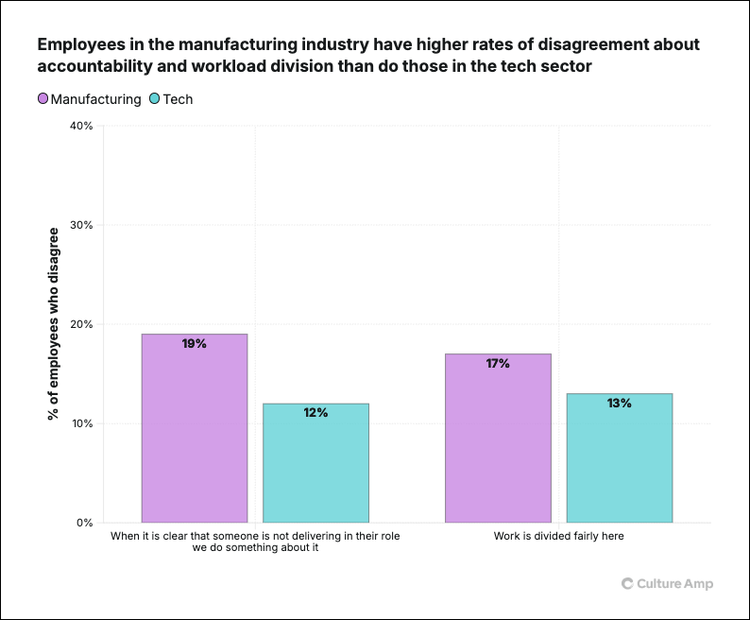
Pair these numbers with the role-clarity scores, and the picture sharpens. Workers who hold the standard clearly see when peers aren’t meeting it, and they’re frustrated when that gap goes unaddressed.
In manufacturing, that frustration isn’t an abstract gripe. The work is physical and interdependent, and when one person slacks on the line, or a shift starts short-staffed, the load falls on whoever is left to absorb it.
Production quotas rarely move. Over time, the workers who remain committed to the standard absorb the difference, and the burnout is real.
One HR leader we spoke with at a large US manufacturer put it plainly: “In some plants, the prevailing mindset becomes ‘I can get away with this,’ or ‘That’s not my job.’ When this perspective takes hold, the focus shifts from pushing the ceiling to protecting the floor, and confidence in leadership erodes alongside it.
Supervisors who have the right structure and tools can maintain a consistent standard across every shift and site, aligning experienced and newer workers around a shared definition of "good." AI-powered coaching helps them deliver feedback in real time and act early, before engagement scores confirm what their top performers already know:
If the supervisor doesn’t act, the best performers will. And they’ll act first.
Walk back onto that plant floor, and all three forces are visible at once: the deskless workforce navigating transformation, the loyalists preparing to leave, and the supervisor caught between technical expertise and the transformation they now lead. The HR leader is positioned to support these frontline teams at scale by empowering them with the tools and resources to navigate the industry’s biggest challenges.
Culture Amp gives HR the levers to act: Engage for mobile-friendly listening on the floor; Perform and AI Coach for supervisors managing performance and leading through change; and Develop for career pathing that keeps multiple generations invested long enough for the knowledge handoff to complete.

Learn how Culture Amp turns frontline insight into stronger leadership across every shift and site, so plants run optimally through the change.

Unlock the 47% advantage: A guide for modern leaders.
Article
Article
Article