

Article
How, when, and why to run an employee benefits survey
Employee engagement
13 min read
Written by

Writer, Culture Amp
Millions watch Formula 1 races, laser-focused on the drivers. But the results of each race depend on an orchestra of specialists performing in unison. Tire strategists, engineers, pit crews, analysts – each person executes a precise role, contributing to the team’s success.
Winning Formula 1 teams and our research at Culture Amp show that high performance doesn’t belong to the individual. It belongs to the collective and the system behind it.
When employees and teams are excited to be at an organization and have fully bought into the company’s vision and strategy, we describe it as a Peak Performance culture. Organizational cultures like this benefit from:
+47% stock price advantage: Over two years, public companies in the Peak state saw a median stock price increase of 36%, while those in other cultural states saw a median decline of -11%. Taken together, companies in Peak Performance have a 47% stock price advantage.
21% more high performers: Peak organizations have a significantly higher concentration of top-tier talent compared to others.
88% retention rate: Companies in Peak experience the highest retention rates, avoiding the compounding cost of unwanted turnover.
76% durability: Reaching the top doesn't mean you are destined to dip; 76% of companies that reach Peak are still there a year later.
So, why exactly is the collective critical to driving this kind of organizational outperformance?
When we dug into our data of over 1,800 organizations, we found that only 11% of employees globally achieved high performance across a six-cycle time frame – and only 2% sustained two consecutive high-performance ratings.
“While high-performing employees are the ideal, individual heroics only created short-lived peaks. Sustainable high performance came from the conditions around people,” writes Heather Walker, Ph.D., Senior Data Journalist, Culture Amp.
Our research shows that organizations that strategically cultivate both employee engagement and organizational performance significantly outperform those that focus on only one.
But if we look at typical HR practices related to engagement and performance, they’re often disconnected: Companies measure engagement at the group level once or twice a year, while giving individual performance ratings at times that don’t align with this schedule. This separation means they’re only getting half the picture of what’s going on in the organization at any point in time.
When systems are disconnected like this, it’s easy for leaders to focus on the wrong things – like individual performance ratings and scores – and completely miss that their company culture is breaking apart and their best people are disengaging.
Organizations need a coherent, always-on culture system that integrates insights on culture, goals, and feedback in one place. When these signals represent a single, living profile of the workforce, leaders gain the clarity to make smarter decisions about how to lead both individuals and the collective – even under tight budgets.
Our research surfaced a clear pattern that predicts an organization’s performance over three years or more. At a high level, the pattern combines employees’ engagement with their confidence in the organization’s success.
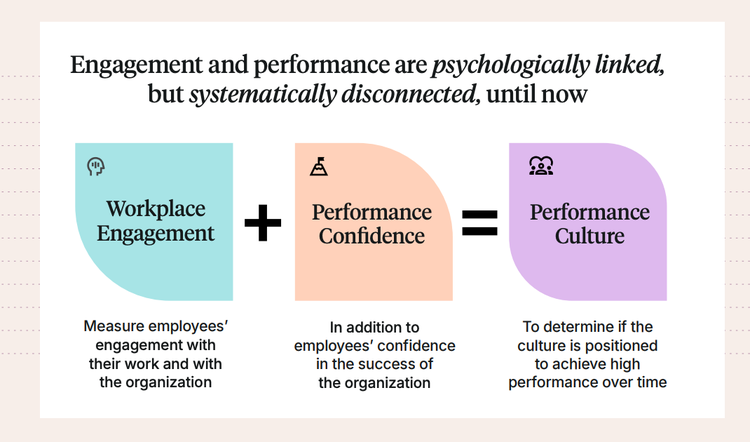
When you have both of these together, you achieve Peak Performance, a culture where employees are engaged with their work and the organization, and are confident in its ability to succeed. Not only do they believe in the vision and strategy – they take responsibility for that success, lifting up those around them.
This is why Culture Amp is moving to a dual-outcome model that recognizes workplace engagement and performance confidence as a single, integrative engine. It not only powers our Performance Culture Quadrant, but also gives companies a map to achieving Peak Performance, no matter which culture they start with.
Based on our Performance Culture Quadrant research, we found five ways that HR leaders can improve their cultures and achieve high performance as an organization:
Break down the silos between engagement and performance measurement, connecting them through a single intelligence layer. This unified view allows you to see how engagement directly fuels performance, turning disparate "people data" into a cohesive strategic map.
Shift your strategy away from relying on unsustainable individual heroics and focus on the collective conditions that drive belief in the organization.
Ensure funding, people, and effort are directed toward company goals, so employees see how their work creates an impact. Use their feedback to accelerate or course-correct on strategic bets.
Prove to your people that you are listening by closing the action communication gap. Sharing and taking visible action on survey results is a universal requirement for reaching Peak.
Support your leaders with AI Coach, which helps them interpret complex signals and provides practical, in-the-moment guidance on how to lead and prioritize.
Peak Performance is not reserved for the rare few. It is a cultural state, and it’s within reach for every company. When you focus on the collective as well as individual performers, you unlock the force multiplier that gets your organization to the next level.
With the right system, you can get a clear view of where your culture stands today – and a practical path to supercharge it, power your business strategy, and attain Peak Performance together.


Unlock the 47% advantage: A guide for modern leaders.
Article
Article
Article