
Article
Employee attrition: What it is and how to calculate it
Employee engagement
9 min read

Written by

Senior Content Marketing Manager, Culture Amp
When was the last time somebody acknowledged the hard work you or your peers were doing in the workplace? More importantly, how often did that acknowledgment extend past a cursory “good job” or “great work?”
We all know positive feedback is important, but we don’t always take the time to think about why. At Culture Amp, we believe positive feedback is much more than a feel-good practice; when done right, it serves as a core development and performance tool that motivates and engages employees. However, to reap the full benefits of positive feedback, you need to be able to differentiate it from praise.
While praise can help lift somebody’s spirit or make them feel better about themselves, it's the clarity offered by effective feedback that leads to the most impactful changes – both for the individual and the business.
In this article, we’ll take a deeper dive into feedback and share our people-science-backed perspective on what is popularly known as “positive feedback.” Then, we’ll share a list of 60+ examples of effective positive feedback you can adapt for your own use.
Positive feedback is more than praise. When done well, it helps people understand what they did well, why it mattered, and what to keep doing.
At Culture Amp, we believe that positive feedback includes both recognition and reinforcing developmental feedback. Recognition acknowledges past contributions and impact, while reinforcing feedback highlights the behaviors you want the person to continue or amplify.
The most effective positive feedback is specific, behavioral, and impact-focused. Using a simple model to frame your feedback, such as the SBI (situation-behavior-impact) structure, can help transform feedback from vague encouragement to something actionable.
At Culture Amp, we define feedback as:
Information about a person’s behavior, work, progress, or impact that a person can use to guide their future improvement.
Unlike praise, feedback focuses on behavior and impact rather than personality or character. In a work setting, the ultimate goal of feedback is to help someone improve their performance, develop in their role, and stay aligned with expectations.
While “positive” and “negative” feedback is a common framework for understanding feedback, it isn’t our recommended framework here at Culture Amp.
Instead, our people scientists recommend looking at feedback as belonging to one of the following three categories:
Recognition
Evaluative feedback
Developmental feedback
Recognition is feedback that focuses on an employee’s effort, contribution, or impact. It’s a form of positive acknowledgment that signals to employees: “I see you, I value what you did, and I acknowledge the difference it made.”
Example of recognition: “I was really impressed by your latest blog post. It was really well-written, and a few of our customers even reached out after reading the article.”
Evaluative feedback clarifies an employee’s relative standing, often in relation to expectations or a rating. It’s intended to help people evaluate how effectively they're doing overall.
Example of evaluative feedback: “You’re consistently meeting expectations in stakeholder communication. Your updates are clear, timely, and help people make decisions with confidence.”
Developmental feedback is future-focused and intended to help someone grow. There are two important subtypes within this category:
Reinforcing: Tells someone what to keep doing
Redirecting: Tells someone what to change, reduce, or do differently
Example of reinforcing developmental feedback: “The way you summarized customer themes was really effective. Keep doing that – it makes your recommendations easier to act on.”
Example of redirecting developmental feedback: “In your next project update, try leading with the key question and risk first. That will help stakeholders respond faster and make the update easier to scan.”
In this framework, positive feedback encompasses both recognition and reinforcing developmental feedback.
While the two are similar, there is one key difference: Developmental feedback highlights the future, whereas recognition recognizes what has been accomplished or achieved in the past.
As an example:
Recognition feedback: “Great job restructuring the deck – it made the story much clearer.”
Reinforcing feedback: “Keep structuring decks that way – it will help leadership make faster decisions.”
Positive feedback is important because it helps people understand what they’re doing well and why it matters. This understanding ultimately strengthens their motivation and engagement, which in turn encourages them to perform at a higher level.
More specifically, effectively given positive feedback:
Amplifies positive behaviors. Reinforcing developmental feedback tells someone what to keep doing, making it easier for them to continue to deliver high-quality work.
Increases motivation and engagement. Culture Amp’s people scientists recognize positive feedback as a core driver of motivation and engagement.
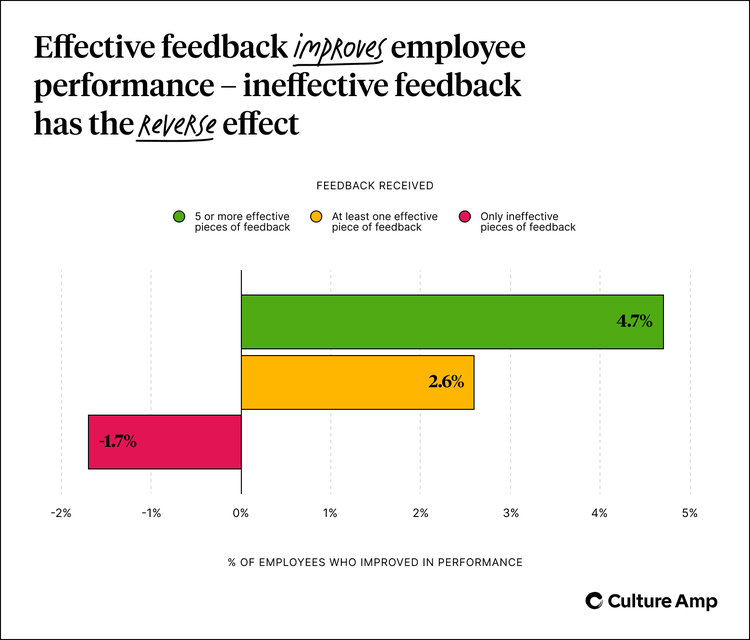
Improves employee performance. Culture Amp research shows that employees who received five effective pieces of feedback were more likely to improve their performance rating in the next review cycle.
Here are some general best practices for giving better feedback:
Be specific. Name the exact behavior or contribution – don’t just say “great job.” Your positive feedback should make it clear what behavior you want to call out.
Explain the impact. Describe how and why their behavior drove a positive impact for their team, customer, or business. This helps people understand what “good” looks like in a specific context.
Use objective language. Focus on what the person did and what happened, not their personality or intent.
Make it future-focused. Positive feedback works best when it makes the next step clear – whether that means acknowledging great work or signaling what someone should keep doing.
Give positive feedback regularly and in the flow of work. Give feedback in a timely manner – positive feedback is most effective when it happens often and in the moment, not just during formal performance reviews.
Keep it genuine, not formulaic. Focus on giving feedback that is authentic and meaningful. Avoid tropes like the feedback sandwich or fixed ratios (e.g., 60% reinforcing / 40% redirecting).
Focus on quality, not quantity. Consider your feedback carefully before delivering it. Quality matters more than volume alone; When feedback is both frequent and effective, it is far more likely to drive performance
To give effective feedback, you may also find it helpful to consider following the SBI framework:
Situation. First, name the specific situation
Behavior. Then, describe the observable behavior
Impact. Finally, explain the impact of the behavior
Using the SBI model, you can ensure that your feedback gives people clear feedback on exactly what they did and why it mattered.
Example of SBI feedback: “In yesterday’s client call, you paused to summarize the customer’s main concerns, which helped them feel heard and kept the discussion on track.”
Situation: Yesterday’s client call
Behavior: Paused to summarize the customer's main concerns
Impact: Helped customer feel heard and kept the discussion on track
To help get you started, we’ve compiled a list of 60+ examples of effective positive feedback you can use or adapt.
Across all of the examples, the goal is the same: to name the behavior, explain its impact, and make it clear what the person should keep doing.
1. You did an excellent job preparing for the client review last week. You anticipated their questions and came in with the right data. Your preparation helped the meeting run much more smoothly.
2. I appreciated how you handled the product launch checklist this week. Your attention to detail helped us catch issues early and avoid last-minute scrambling.
3. The way you onboarded our new team member last week was really thoughtful. You gave them important context and answered their questions patiently and thoroughly.
4. You’ve been doing a great job keeping stakeholders updated on recent project progress. Your summaries have reduced confusion and helped everyone stay aligned.
5. I noticed how calmly you handled that customer escalation yesterday. You stayed focused on solutions, which helped us move the conversation forward.
6. You made a lot of great improvements on this quarter’s SEO deck. The narrative became much easier to follow, which helped leadership clearly understand our projects and current performance.
7. I really value how proactive you’ve been about flagging risks early in the latest product sprint. It’s making our planning much more realistic.
8. The way you facilitated the retrospective encouraged everyone to contribute. That created a more open discussion where everyone felt safe to share their true opinions.
9. You’ve shown strong ownership of our website refresh project. You followed through on open items without needing reminders, which made the whole team more efficient.
10. I appreciated the way you stepped in to support the team during a busy week. Your flexibility helped us maintain momentum without compromising quality.
11. I really appreciated how you jumped in during our planning session. Your questions helped us clarify our priorities before we moved too far ahead.
12. The way you summarized the customer themes after the interviews was really helpful. It made the findings easier to understand and act on.
13. You’ve been a strong thought partner on this project. Your feedback consistently sharpens our work and improves our methodology.
14. I noticed how you made space for quieter voices in the meeting. That really helped our conversation feel more inclusive and brought out innovative ideas that may not have surfaced otherwise.
15. Your follow-up after the workshop was great. The recap was clear, actionable, and concise.
16. Thanks for being so responsive during the launch. Your quick decisions helped us keep things moving and reduced bottlenecks across teams.
17. I appreciate how organized you were during the last campaign launch. It makes collaboration easier and helps everyone feel more confident about who owns what.
18. You handled that handoff really well. The context you shared saved me time and made it much easier to keep the work moving.
19. I admire how you approached problem-solving during last week’s meeting. You stayed calm, asked good questions, and helped the team maintain focus on what mattered most.
20. Your feedback on my previous draft was so helpful. It was specific, constructive, and gave me a much clearer idea of how to improve the final version.
21. Your communication during the reorg was so helpful. You were transparent about what you knew from the start, which made the change feel more manageable.
22. I appreciate you making our 1-on-1s feel like safe spaces. It makes me feel more comfortable raising questions and sharing my true opinions.
23. The way you advocated for the team in the planning meeting helped ensure our workload and priorities were respected and understood.
24. You did a great job framing our team’s goals for this quarter. The clarity made it easier for me to understand where to focus and how my work connects to the bigger picture.
25. I’ve noticed that you’re really intentional about recognizing people’s contributions in meetings. That has a positive impact on morale and makes me and the team feel seen.
26. Your coaching on the presentation last week was really valuable. The questions you asked helped me sharpen my story and anticipate the questions that would come up.
27. I appreciate how quickly you remove blockers when they come up. That responsiveness helps me maintain momentum and stay focused on execution.
28. The way you handled the conflict between teams last week was thoughtful and fair. You kept the discussion productive and helped everyone leave with a clearer path forward.
29. You’ve been doing a strong job connecting day-to-day work back to our strategy. That context makes the work feel more meaningful and easier to prioritize.
30. I value how open you are to feedback from the team. It’s made it easy for me and others in our team to speak up.
31. You were a great collaborator on this project. You kept people informed, followed through on commitments, and made it easier for the team to move quickly.
32. I appreciated how you checked in with other teams before finalizing the plan. That extra coordination helped us avoid repeat work.
33. You did a great job sharing credit throughout the project. It reinforced that this was a team effort and built a lot of goodwill.
34. The way you supported your teammates during the deadline crunch was really impactful. It helped the team stay on track, even when things were getting really stressful.
35. You consistently make cross-functional work easier by clarifying decisions and next steps. That’s helping us collaborate more effectively, especially on our most recent project.
36. I noticed how quickly you aligned the group after priorities shifted. You helped us refocus the project and rebuild morale without losing momentum.
37. Your update in today’s meeting was really clear. You highlighted the key decision, the main risk, and what you needed from the group, which made it easy to respond quickly.
38. I appreciated how you adapted your message for the audience in the all-hands. You made a complex topic feel accessible without oversimplifying it.
39. The recap you sent after the client call was excellent. It captured the important details and gave everyone a clear view of next steps.
40. You handled that difficult conversation with a lot of care. Your tone was direct but respectful, which helped keep the conversation calm but well-considered.
41. I noticed how closely you paid attention during the workshop. You reflected people’s points back clearly, which helped others feel heard and improved the discussion.
42. The way you communicated the project delay was strong. You were transparent about the issue and proposed a thoughtful path forward, which helped maintain trust.
43. You showed strong leadership during the launch. You kept the team focused, made decisions carefully but decisively, and created calm during high-pressure moments.
44. I appreciated how you always try to set a clear direction without micromanaging. During the last launch, it gave the team enough structure to move confidently while still allowing them the flexibility to use their own judgment.
45. I really admire the way you recognized people’s contributions in the team meeting. Your feedback was so thoughtful and caring, which really boosted morale and realigned expectations on what we’re working so hard to achieve.
46. You did a great job coaching your direct report rather than trying to solve everything yourself. That approach will help your team members build confidence and capability over time.
47. I noticed how thoughtfully you handled competing priorities this week. You made the tradeoffs clear, which helped us stay aligned.
48. Your leadership in this week’s planning session stood out. You balanced big-picture thinking with practical next steps, which helped turn discussion into action.
49. You did a great job on the presentation. The structure made your key points easy to follow, and the examples helped bring our message to life.
50. I appreciated how prepared you were for the project debrief. Your reflections were honest and thoughtful, and they helped the team identify useful lessons.
51. The way you opened the presentation was really impactful. You immediately framed the problem clearly, which made the rest of the story easier to understand.
52. Your work on the final deliverable was strong. It was polished, on time, and gave stakeholders confidence in the recommendation.
53. You handled the Q&A portion really well. You stayed composed, answered directly, and built credibility with the audience.
54. I appreciated how you wrapped up the project. Your documentation and handoff made it much easier for others to build on your work.
55. I really appreciated how you took the initiative to investigate the issue before escalating it. That saved time and helped us move to a solution faster.
56. I was impressed by how you navigated the ambiguity in this project. You made smart assumptions, kept people informed, and maintained momentum.
57. Your problem-solving on the reporting issue made a real difference. You found the root cause quickly and helped prevent the same issue from happening again.
58. I appreciate that you don’t just flag problems – you always try to come in with possible solutions. That makes it much easier for the team to make progress.
59. I noticed how proactively you sought out customer context before making a recommendation. That made your solution much stronger and more relevant.
60. The way you simplified that messy workflow was really valuable. It reduced friction for the team and made the process easier to scale.
61. You’ve shown a lot of initiative in identifying opportunities beyond your core scope. That broader thinking is already improving how we work.
62. I appreciated how you used data to guide your recommendation instead of making assumptions. It made the decision more credible and helped us gain the leadership buy-in we needed.
Looking for more feedback ideas? Check out our blog on feedback examples to guide growth and development.
Effective positive feedback is clear, specific, and grounded in real work. But building that kind of feedback habit consistently can be difficult, especially when people are busy, unsure how to phrase what they want to say, or saving feedback for formal review cycles.
That’s where Culture Amp can help.
Whether someone is writing feedback, preparing for a more nuanced conversation, or sharing recognition in the flow of work, Culture Amp offers tools to support each part of the process:
Suggest Improvements helps managers, peers, and direct reports strengthen written feedback by making it more objective, specific, action-oriented, and impact-focused.
AI Coach helps leaders draft, refine, and role-play feedback conversations before they happen, which can be especially useful in higher-stakes or more complex situations.
Shoutouts make it easier to recognize employees in the flow of work.
360-degree feedback tools create regular opportunities for reflection and feedback, up, down, and laterally across your organization.
Performance reviews, goal comments, and 1-on-1s give teams more structured ways to capture feedback, revisit it over time, and connect it directly to development and outcomes.
Ultimately, Culture Amp helps organizations build a feedback culture where positive feedback is not just a nice gesture, but a meaningful part of how people learn, grow, and stay connected to their work.


Unlock the 47% advantage: A guide for modern leaders.
Article
Article
Article