

Article
Employee attrition: What it is and how to calculate it
Employee engagement
9 min read
Written by
Writer, Culture Amp
If you’re interested in improving employee engagement, you’ve likely seen articles that promise fast results with their “top 10 tips.” But meaningful changes to company culture don’t work that way. Improving employee engagement isn’t about quick wins or one-size-fits-all solutions. It takes time, intention, and a deep understanding of what your people actually need, because a strategy that works well for one organization may fall flat in another.
The good news? When you listen to your people and make data-driven investments in engagement, the impact is real. With consistent effort, you can drive better performance, increase retention, and build a culture people want to be part of.
In this article, we explore how to improve employee engagement, why engagement is important to business success, and the strategies that drive lasting change. You’ll learn how to identify key engagement drivers and turn insights into effective, data-driven action.
Employee engagement reflects how people feel about their organization.
Engagement is an outcome, shaped by key drivers like leadership, growth opportunities, and company performance.
By identifying and acting on the drivers that affect engagement at your organization, you can take focused, meaningful steps to improve engagement over time.
Employee engagement represents the levels of enthusiasm and connection employees have with their organization. High engagement means employees are more likely to stay longer and go the extra mile in their roles, which can translate into stronger business performance and improved profitability over time.
While the benefits are clear, improving engagement isn’t always straightforward. Many organizations struggle with how to improve employee engagement, because they fail to understand that engagement is an outcome shaped by multiple factors, from leadership and team dynamics to management, tools, and the overall work environment. Without a clear grasp of what matters most, efforts to improve engagement can easily miss the mark.
That’s why at Culture Amp, we’ve traditionally measured engagement through five questions grouped into three themes: advocacy (pride and recommendation), commitment (present and future), and motivation – capturing how employees feel about their organization and their willingness to stay and go above and beyond.
Pride: How proud an employee is to work for your company.
Recommendation: Whether an employee would recommend your company as a great place to work.
Present commitment: The employee’s current feeling of commitment, often measured by how rarely they think about leaving.
Future commitment: The employee’s belief that they will still be at the company in the future.
Motivation: An employee’s drive to go above and beyond in their role.
To truly understand how to improve employee engagement, organizations need to track it over time. Regular employee surveys that track these engagement components over time can reveal where your company is thriving and where there’s room to grow, giving you the insight needed to take meaningful action.
We think about employee engagement in two ways: how people feel about the organization and how they experience their work each day.
In simple terms:
Organizational engagement reflects how employees feel about the company itself (Would I recommend this company to a friend? Do I see a future for myself here?)
Workplace engagement goes deeper. It encapsulates both an employee's connection to the organization, as well as how dedicated and absorbed they are in their work: the enjoyment, immersion, and sense of belonging they experience day to day. (How committed am I to this company, and how energized and absorbed am I in my work here?)
This distinction matters because engagement isn’t just about retention or advocacy. An employee could stay with a company for many years, all the while feeling disconnected from their work. True engagement happens when individuals love your company and their role.
That’s why Culture Amp’s Performance Culture Diagnostic approach measures workplace engagement as a key outcome, helping organizations understand not just whether employees are staying, but whether they’re thriving.
To help organizations understand how to improve employee engagement in a meaningful way, Culture Amp developed the Performance Culture Diagnostic, which measures two key factors:
Workplace engagement, or how connected, dedicated, and absorbed employees feel in their work and organization.
Performance confidence, or how confident employees are in their organization’s ability to succeed.
These outcomes are underpinned by six key dimensions: Excellence, Vision, Ownership, Learning, Voice, and Energy (EVOLVE). These dimensions span across the organization, manager, and team levels.
To bring these insights to life, results are mapped on the Performance Culture Quadrant (PCQ), which places organizations into one of four culture states: Peak Performance, Engaged Skepticism, Strained, or Disconnected. This chart helps leaders understand where their business sits today – and, more importantly, where they want to be in the future.
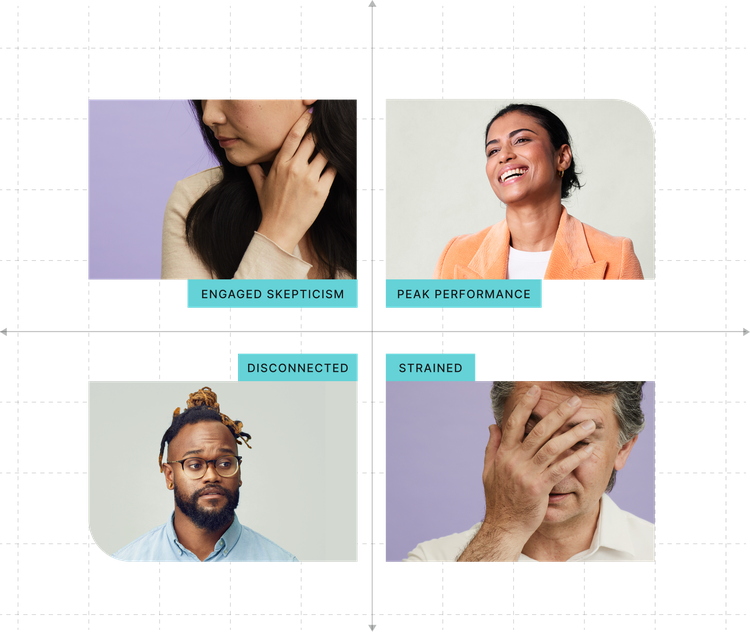
Want to learn more about how our approach to engagement is evolving? Explore our Performance Culture Quadrant™ page.
If you need to build buy-in for engagement initiatives, the evidence is clear: Higher employee engagement is consistently linked to stronger business outcomes.
Here are some of the key ways improving engagement can benefit your organization:
Increased profitability: Organizations with engaged employees often outperform their peers financially. In fact, one Culture Amp study found that a modeled composite customer unlocked $963,000 in risk-adjusted profit over three years by improving engagement.
Lower turnover: Engaged employees feel more committed to their teams and organization, making them more likely to stay longer. That means your business can save big on turnover costs!
More innovation: Engaged employees are more likely to think creatively and exhibit innovative behavior, helping businesses stay competitive and forward-thinking.
Better employee performance: Culture Amp research shows that high-performing employees are also the most engaged, and that stronger engagement is linked to a higher share of top performers.
Reduced absenteeism: According to Gallup, highly engaged workplaces see 81% lower absenteeism, helping maintain productivity levels.
Fewer workplace incidents: Engagement also impacts safety. Organizations with high engagement are 64% less likely to experience workplace incidents.
Customer satisfaction: Engagement doesn’t just affect internal outcomes – it shapes the customer experience. Culture Amp research shows that companies with above-benchmark engagement scores see 10% higher customer satisfaction.
Put simply, investing in employee engagement doesn’t just benefit your people, it drives better results across your entire business.
Every organization is different, and engagement is shaped by a unique mix of experiences, expectations, and cultural factors. That’s why employee engagement surveys are so valuable – they help you uncover what matters most to your people.
However, across industries, some patterns consistently emerge. Culture Amp data shows that the strongest drivers of employee engagement are leadership, learning and development (L&D), and company performance. These drivers have remained stable over time – and are becoming even more predictive of engagement.
Leadership sets the tone for the entire organization. In fact, Culture Amp data shows it’s consistently the top driver of engagement globally. From communication style to decision-making and transparency, leaders shape the culture employees experience every day. When leaders communicate clearly, act with integrity, and demonstrate that people matter, it builds trust and confidence. This, in turn, strengthens engagement.

I have confidence in the leaders at [Company]
The leaders at [Company] demonstrate that people are important to the company's success.
Employees want to grow. They want to feel challenged, supported, and confident that their time at your organization is helping them build skills for the future. When people see clear opportunities for development – whether through training, stretch projects, or career progression – they’re more likely to stay engaged and motivated.
[Company] is a great place for me to make a contribution to my development
[Company] effectively directs resources (funding, people, and effort) towards company goals
When employees understand how the company is performing and believe in its future strategy, it creates a sense of stability, purpose, and confidence in what’s to come. It also reinforces that their work contributes to something meaningful. Clear communication around company goals, progress, and outcomes helps employees stay aligned, motivated, and confident in the future.
The leaders at [Company] have communicated a vision that motivates me.
The leaders at [Company] keep people informed about what is happening.
I know how my work contributes to the goals of the company.
Follow these concrete strategies to measurably start improving employee engagement within your organization today.
The first step towards improving employee engagement is to measure it. Regular employee engagement surveys help you gather the data and feedback needed to understand what’s working within your organization and where you have room to grow.
It’s important to remember that engagement is an outcome. To understand what drives it, you need to ask the right questions about the experiences shaping your workplace (i.e., wellbeing, DEI, manager effectiveness, etc.).
To help you get started, here are a few useful resources:
Explore our list of employee engagement questions to find the right questions to ask
Learn how to write your own with these tips for creating effective survey questions
Looking for a lighter approach? Check out this guide to employee pulse surveys
When it’s time to analyze your survey results, you’ll need to conduct a statistical technique called driver analysis. A driver analysis determines the actions that are most likely to move the needle on a particular outcome.
For example, if your survey results reveal that your company has an unfavorable score for work/life balance, you might assume making improvements in this area will help lift engagement. But if work/life balance isn’t something that drives employee engagement at your company, investing in this area won’t make a difference to engagement levels.
Culture Amp’s real-time driver analytics engine and Focus Agent allow you to quickly and efficiently see what aspects of organizational culture have the biggest impact on employee engagement. Because every company’s drivers are different and can even evolve over time, our tools make it easy to pinpoint what matters most in your organization. That way, you can focus on the right areas and ask the right questions to effectively measure and improve engagement.
After working with culture-first organizations for years, one pattern stands out: The most effective companies don’t try to fix everything at once. Instead, they focus on doing less, but doing it well.
Rather than spreading their efforts too thin, high-performing organizations prioritize one (or two at max) key drivers of engagement. This focused approach leads to more meaningful, measurable change.
To identify where to act, challenge yourself to choose a specific focus area. These three steps can help guide leaders at every level:
Use advanced people analytics: Leverage survey tools, like Culture Amp’s embedded focus agent, to identify the areas that will have the greatest impact on engagement. Tools like this help you move from broad feedback to a focused, high-impact shortlist.
Align with business goals: Review feedback alongside your organization’s strategic priorities. Choose a focus area that not only improves the employee experience but also supports broader business outcomes.
Involve your team: If priorities aren’t immediately clear, ask your team. A simple vote can help surface what matters most. Start with the top choice, and keep other ideas on hand for future action.
Need help finding your focus? Culture Amp’s Action Framework and Inspiration Engine take the guesswork out of survey analysis, helping teams select one or two high-impact focus areas and explore proven actions.
Once you’ve identified your focus area, the next step is to dig deeper and understand the root cause. This might involve a short follow-up survey or a small focus group to gather both qualitative and quantitative insights.
Framing your exploration as a “How might we…” question can help guide the conversation. For example: How might we improve collaboration across organizational boundaries?
You can ask employees:
What does this focus area mean to you?
Where are we doing well?
Where are we not doing well?
These insights will help you take a more informed, targeted approach to crafting an action plan, ensuring your efforts address the right problems and lead to meaningful change.
Now it’s time to turn insights into action. Using your survey data and employee feedback, build a focused action plan to address your chosen engagement driver.
For example, if collaboration is a key driver, you might introduce new tools to support cross-team work, create more opportunities for team connection (like offsites), or establish clearer processes for working across departments.
Don’t wait for perfection. The most effective action plans are iterative – test ideas, measure progress, and refine as you go. And, keep employees informed of your plans along the way so they can see their feedback is driving real change. This transparency not only builds trust but also encourages more honest, valuable feedback in the future.
Improving engagement isn’t a one-time effort. Ongoing measurement through regular engagement and pulse surveys helps your organization understand whether your actions are working and where to adjust.
Tracking engagement over time allows you to identify new drivers, refine your focus, and evolve your strategy as your organization and engagement drivers change. It also helps demonstrate the impact of your efforts, making it easier to build and maintain leadership support for future initiatives.
Wondering what identifying drivers and taking action looks like at other companies? Here’s how two Culture Amp customers cracked the code on how to improve employee engagement in their organizations.
OLX, a global leader in the online marketplace industry, wanted to strengthen its employee listening, culture, and engagement strategies. Through employee feedback collected using Culture Amp, OLX identified a critical challenge: Trust and confidence in the company had declined following a period of great change.
Taking action, the company prioritized better alignment between leadership, company strategy, and employees’ day-to-day work by rolling out workshops, roadshows, and team offsites to clearly communicate the company’s vision and connect each employee’s role to broader business goals. These efforts had a measurable impact on the company as trust and clarity scores increased by 15 points. By prioritizing consistent and transparent communication, OLX created stronger alignment and deeper engagement across the entire organization.
Munson Healthcare, the largest healthcare system in Northern Michigan, recognized that improving patient safety starts with a more engaged workforce. To move beyond intuition, they partnered with Culture Amp to better understand how employee engagement influenced outcomes across the organization.
By conducting a linkage analysis, Munson Healthcare uncovered a clear connection: When organizational employees felt more committed and engaged, it strengthened the broader workplace culture. That shift had a direct impact on patient-facing teams, improving collaboration, stability, and ultimately, patient safety scores.
The result? These insights proved that engagement is a critical driver of better outcomes, including improved patient care, which helped the Munson people team secure leadership buy-in for ongoing culture and improvement efforts.
Read the full Munson Healthcare case study.
While it can be challenging to figure out which factors will truly boost engagement in your organization, you don’t have to rely on guesswork. The right tools can help you identify key drivers and take targeted action with confidence.
With Culture Amp Engage, you can run regular engagement surveys, analyze results in real time, and receive AI-powered recommendations, so you know exactly where to focus and how to improve employee engagement in a way that drives meaningful results.

Request a free demo of Culture Amp Engage today to get started improving engagement at your company.
Businesses can increase engagement by listening to employees regularly, acting on feedback, and focusing on key drivers like leadership communication, growth opportunities, and alignment with company goals. Consistent, visible action and clear communication help build trust and sustain engagement over time.
A “good” employee engagement score varies based on factors like industry, company size, and region. While benchmark data, like Culture Amp’s engagement benchmarks, can provide helpful context, the most valuable approach is to establish a baseline within your own organization and focus on steady improvement over time. This strategy typically benefits your employees and business more than aiming to hit a specific number.
While every organization has its own unique drivers, Culture Amp data shows that leadership, learning and development, and company performance are among the most consistent. When employees trust leadership, see opportunities to grow, and feel confident in the company’s direction, engagement is more likely to increase.
Improving engagement takes time and consistent effort. While small wins can happen quickly, meaningful and sustained change often takes several months to a year, depending on the actions taken. Follow through on your action plan and continue to measure engagement regularly to understand how your efforts are moving the needle within your organization.

Unlock the 47% advantage: A guide for modern leaders.
Article
Article
Article