

Article
How, when, and why to run an employee benefits survey
Employee engagement
13 min read

In tennis, matches aren’t won with a single, spectacular shot. They’re decided by what happens across dozens – sometimes hundreds – of points, including how players adjust, recover, notice patterns, and respond in the moment.
This type of success is often described as “winning between the points.” Justin Angsuwat, Culture Amp’s Chief People Officer, explored what managers can learn from this concept at the Gartner HR Symposium/Xpo.
Even if your managers don’t play tennis, the idea of winning between the points is relevant to their work. Today’s managers are no longer solely evaluated on how they show up in strategy sessions, conduct employee performance reviews, or lead high-profile projects. Instead, manager performance is increasingly shaped by everyday interactions that add up over time.
“It’s that 1-on-1 that sparks that moment of trust,” Justin explained. “It’s that one piece of feedback they give after a really tough conversation. It’s that one piece of growth advice that sparks a change in someone’s career.”
Those moments might feel small in isolation, but together, they’re where performance, trust, and engagement are built or lost.
Here’s a closer look at why these moments matter, why managers are struggling to keep up –and how AI can help leaders win between the points.
Even when managers recognize the importance of everyday interactions, making the most of them is often difficult, because managers are under increasing amounts of pressure.
That pressure comes from every direction. Growth is now the top priority for CEOs, even as organizations continue to ask leaders to operate leaner and move faster. “We’re all hearing it as HR leaders: Do more with less,” Justin said. “But managers are the frontline of that.”
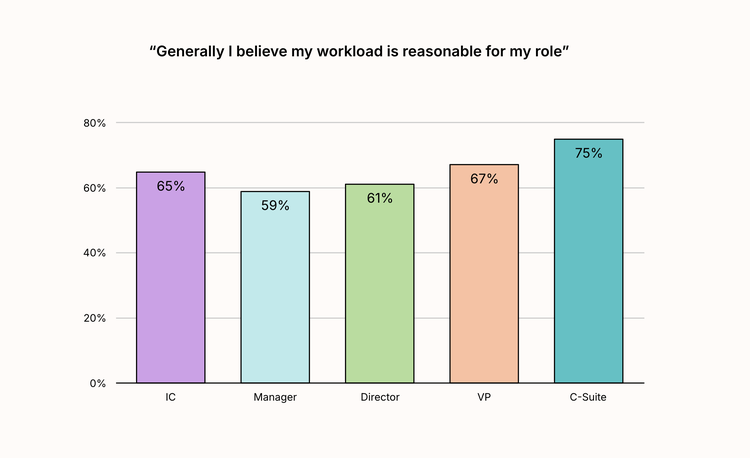
At the same time, managers’ day-to-day responsibilities are heavier than ever. When compared with individual contributors, directors, VPs, and even the C-suite, managers are the least likely to believe their workload is reasonable for their role.
To some, AI might seem like the panacea for managers who are spread thin, but Justin offered a word of caution, reflecting on a previous technological advance. When email was first released, the promises were similar to the ones we’ve been hearing about AI: “Think of all the time you’re going to get back.” And then, relatively quickly, email became the work.
If managers aren’t careful, they risk repeating that pattern with AI. AI is often framed as a time-saver, but it can also add expectations and noise – and managers are likely to feel that weight more than anybody else.
Instead of asking your managers to do more, help them focus on what actually makes an impact.
How can we strip away some of the noise and boost the moments that actually matter? This is where AI can change the game.
Justin Angsuwat
Chief People Officer, Culture Amp
Justin believes one way AI supports managers is that “it sees the patterns in between the points – the things that we forget.”
These gaps are especially meaningful in employee performance management. In fact, many leaders no longer believe traditional performance management systems actually drive performance. “We all know feedback is incredibly important,” Justin said. “But we’re limited in our performance management process by humans. We’re limited by the amount of information a human can process during a review.”
That means critical context often gets lost. Notes from 1-on-1s, bits of feedback shared in passing, signals buried in messages or project updates – they rarely make it into formal reviews.
“AI can aggregate all of that information,” Justin explained. “It can pull from 1-on-1s, anytime feedback that’s given throughout the year. It can pull from messaging. It can pull from project management or performance management.”
Using AI tools in employee performance management helps leaders recognize and highlight key insights. “AI can surface up to the five most important pieces of feedback that you need to give that direct report,” said Justin. “The power is in collecting those data points between those cycles throughout the year.”
And this specific, personalized feedback isn’t just helpful – it’s contagious. “When we looked at the behaviors that direct reports copy from their manager, one of the biggest ones is giving continuous feedback,” he noted. In fact, when a manager gives continuous feedback, their direct reports are 19.7 times more likely to do the same.
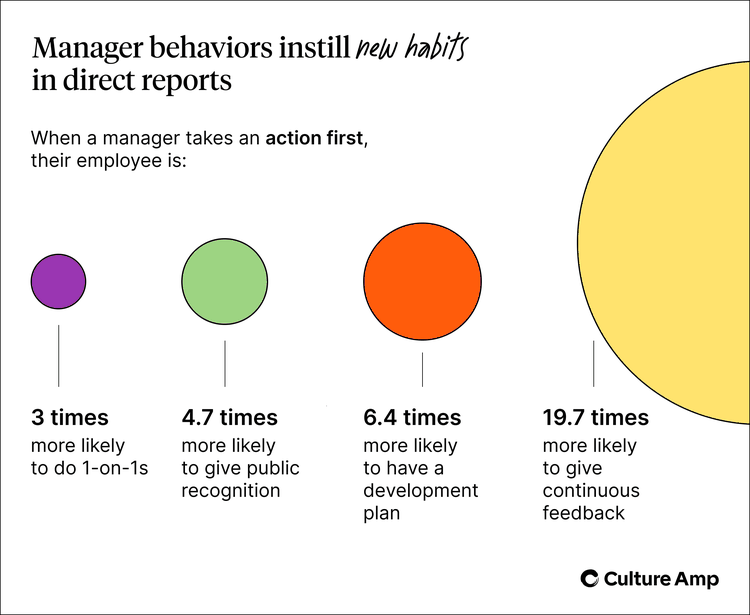
Managers don’t struggle to understand the value of feedback. They struggle to give the right feedback in the moments that actually shape employee performance.
“AI is not here to replace all of that,” Justin emphasized. “AI is here to help structure that feedback and nudge you in the moment that matters so you can give that continuous feedback in between the points.”
Everyday interactions shape engagement too – not just performance. And right now, there’s a growing disconnect.
According to Culture Amp data, since 2021, employees have had more opportunities to see and discuss employee survey results. Yet, their confidence that those results will actually lead to change has continued to decline. “That gap erodes trust,” said Justin.

The issue isn’t a lack of data. It’s what happens – or doesn’t happen – after the data shows up. Leaders and managers are often left staring at dashboards, unsure where to focus or what action will make the biggest difference. This is another area where AI tools can be useful.
With Culture Amp’s AI Coach, that translation from insight to action happens much faster. Managers can prompt the AI tool with a simple question like, “What should I pay attention to?” From there, the AI draws on a thematic agent that looks across engagement data to surface the most important patterns. Then comes the next step: deciding what to do about it. AI can help managers with that, too.
As an example, Justin suggested asking, “Okay, what’s the best action I can take to do something about this?” At that point, the AI tool shifts from identifying themes to recommending action, generating a clear, practical plan that managers can actually execute.
“Within the span of 20 minutes, we can turn an engagement survey from a bunch of data to actionable insights,” said Justin. “It doesn’t replace the conversation. It accelerates action.”
“AI is just a tool,” Justin told the Gartner HR Symposium/Xpo audience. “But it’s changing how decisions get made, how we collaborate, and how we work.”
AI works best when it has context. At Culture Amp, that context comes from grounding our AI tools in people science and organizational reality. AI can draw from your company values, strategy, goals, vision, mission, competency frameworks, past employee performance reviews, engagement results, and more, as it supports managers in determining the best next steps.
“With that, AI becomes more of a coach,” Justin continued. “That’s how we can help managers make the right moves in between the points.”
While AI plays a supporting role, effective leadership still happens “in those everyday, human moments where a manager shows up,” Justin concluded. “AI isn’t here to replace those moments. It’s here to amplify them.”

AI Coach accelerates high performance through instant insights, expert coaching, and targeted action plans – all tailored to your organization.

Unlock the 47% advantage: A guide for modern leaders.
Article
Article
Article