Podcast
Bob Sutton on building a workplace with healthy friction and no assholes
Employee experience
66 listen
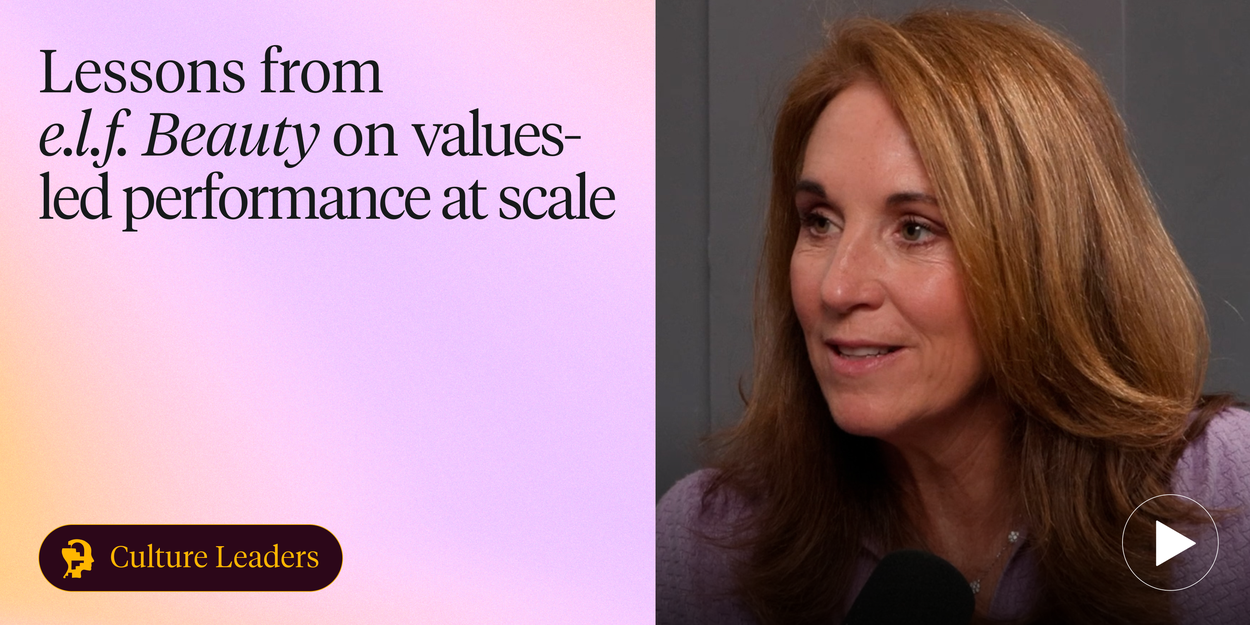
In the fast-paced world of cosmetics, e.l.f. Beauty has become as famous for its internal culture as it is for its products. While many companies struggle to stay connected as they scale, e.l.f. has doubled down on a simple but radical idea: knowing your people as humans is the only way to drive high performance.
In this episode, Kerry, Vice President, People Development, E.L.F Beauty sits down with Culture Amp’s Chief People Officer, Justin Angsuwat, to pull back the curtain on the rituals that make e.l.f. unique. She explains the "Sunday night review" for relationship-building, why the company grants equity to every employee, and how they’ve replaced traditional performance reviews with real-time, pinpointed feedback. Kerry also dives into the "Glampus" of e.l.f. University and shares her advice for leaders on becoming a "choreographer of chaos" in high-growth environments.
Show notes:
Key Takeaways:
Operational skills can be taught, but real connection comes from seeing people and making them feel valued. Kerry advocates for building "flashcards" of personal details – pets, passions, and family – to ensure leadership remains human as the organization grows.
True alignment comes when everyone has a stake in the mission. By granting equity to every employee and accompanying those grants with handwritten notes from the CEO, e.l.f. ensures that "One Team, One Dream" is a financial reality, not just a slogan.
To maintain agility, leaders must resist the urge to over-engineer processes. e.l.f. uses unscripted "Ask Me Anything" sessions to build trust and ensure transparency throughout he company's rapid growth cycles.
In high-growth environments, disruption is constant. Rather than getting lost in the "fireworks" of daily challenges, effective leaders learn to rise above the noise to provide a clear path forward for their teams.
If you've enjoyed this episode, consider checking out more of our podcast. You can follow us on Spotify, Apple podcasts or Youtube.
[00:00:00] Justin: There's a number that keeps coming back in this conversation, and it really made me do a double take. The first time I heard it, that's 97%. That's the percentage of e.l.f. Beauty employees who say they feel passionate about the people that they work with, not proud of the brand, not satisfied with their role, but passionate.
About their teammates in a company growing super fast and disrupting one of the biggest industries in the world. So how does that actually happen? That's what we set out to find out today with Kerry Preston, VP of People Development at e.l.f. Beauty. What she shares in this episode isn't just a playbook, although that'd be awesome on its own.
It's a philosophy one that starts with a simple idea. Her very first CEO gave her decades ago, which is know your people, like really know them and everything else follows from there. We're talking about a company that grants equity to every single employee, A CEO, who hand writes over 600 personalized notes a year, and a feedback culture.
So real time it would make many organizations feel pretty uncomfortable. But here's what really stuck with me. Kerry doesn't see any of this as a trade off with performance at e.l.f.. Boldness and kindness aren't opposites. They're the same
thing, and she's got the results to prove it.
Good day there. I'm Justin Angsuwat.
I'm the Chief People Officer at CultureAmp, and today I'm excited to be talking with Kerry Preston, the VP of People Development and one of the leading beauty brands in the world. e.l.f. Beauty. Alright, so before we ask you questions and grill you about ELs, fantastic success, I wanna play a game with you.
It's a card game that we created a culture app with noted therapist, Ester Perel. It's called Where Should We Begin At Work. So let's pick a couple of cards to ask each other.
[00:01:53] Kerry: Love a good game.
[00:01:54] Justin: Let's get this going. So. So this card's just to get to know you a little bit better. And the first question I'm curious to hear your thoughts on is a piece of advice I still think about
[00:02:08] Kerry: people are the core to culture.
And I had my first CEO ever, I worked at Calvin Klein cosmetics. It was in the early, early. I won't even say the year. And the CEO said to me, Kerry, make sure you do a Sunday night and review.
[00:02:28] Justin: Mm-hmm.
[00:02:28] Kerry: And I said, I'm not sure exactly what you mean. And she said, you have to know the people, the operational side of the business, you can learn.
But the real connection comes from seeing people, making them feel valued. And so we used to build these flashcards. Mm-hmm. And we'd take headshots of the people, we'd write their pets. Names their, you know, details their, we didn't use personality style assessments at that point yet, but it was more just to get to know them as humans see them and, and I've still followed that practice.
Actually, our CultureAmp survey, 97% favorability in passionate relationships. So the best piece of advice is simply know your people.
[00:03:07] Justin: That's incredible. So how do you still do that now? How do you prioritize something like that in times now where it feels like everyone's under the pump? It's all about efficiency.
It's all about squeezing out more time, but you still invest the time in doing that. Like do you just protect the time? It's just something that like everyone does or executives do,
[00:03:24] Kerry: it's, it's definitely something our executives do. You know, our, our CEO Tarang Amin Chairman of the board schedules one-on-ones with our entire leadership team, the access to our entire.
Calendar for anyone and everyone to meet and really get to know each other. There's a lot of other rituals we build in to to spend time building those passionate relationships.
[00:03:48] Justin: Love that. I'll get to those rituals later. And so for those that might be thinking about doing something like that, what's one of the most powerful things that you know about someone that you found like really is quite useful?
[00:03:58] Kerry: You know, what makes them tick? We're a leverage your strengths company. Yeah. So to really understand that someone values strategy, that someone values collaboration, that someone has a high need for responsiveness, you really just learn the nuances. We host leadership team dinners with people, so we get to know each other's spouses and significant others, or you know, other family members or friends.
So. To me the the time is the currency. Yeah. It's fixed. You don't use it, you lose it. There's no overdrafts. So putting that in with intention.
[00:04:34] Justin: Yeah.
[00:04:35] Kerry: Is what matters most.
[00:04:37] Justin: I love it. It's one of the big rocks that you put in first. It's definitely big rock.
[00:04:40] Kerry: Yes.
[00:04:41] Justin: Amazing. Thank you for sharing. So I will ask myself a question, the skill I
[00:04:45] Kerry: like to play.
I'll ask you the
[00:04:46] Justin: question. Go. You can ask the question. I'll God.
[00:04:48] Kerry: Let's have some fun. All right, Justin, what's the skill you wish you got to use more?
[00:04:54] Justin: Apart from going back into Excel again, I actually quite like Excel. Um, but the, the skill I actually wish I could use more is, uh, storytelling. And so that's a part of my job now is to, to evangelize and not just our product, but I spend a lot of time with CHROs or Chief People Officers around the world and hearing about what's on their mind.
And one thing that's really interesting is, um, these chief people officers are across many different industries, and even though the companies are unique, their problems are not. Mm-hmm. And so what I love doing is being able to bring their stories together.
[00:05:29] Kerry: So what's on your mind?
[00:05:30] Justin: What's in my mind is, um, we're transitioning from this world where it's all about performance and we're transitioning to the world of ai, where that's becoming the, the, the most important topic.
And one thing that's on my mind right now is this concept of a productivity paradox where we've spent so many years becoming more productive, where we have tools now, like, you know, think about email that was didn't exist in the nineties, that, uh, that's that's here right now. And. I remember hearing these stories of email being first introduced in the nineties, and people were like, great.
I don't have the fax anymore. I don't have to wait days before I hear an answer. I can hear an answer. Instantly, um, that's gonna make my work so much more efficient. What am I gonna do with the rest of my time, what I'm gonna do with the second half of my week? Um, and all of a sudden email became the work, like inbox became the work.
And so this kind of productivity tool that was supposed to make us more productive has, but now we're seeing tools that make email more efficient and kind of tools upon tools. And so we. Everyone probably has a dozen productivity tools at their fingertips, but we're not feeling as productive right now.
We're seeing productivity flatline and in some cases start to decrease. That's what's on my mind right now as I chat to these rows is like, what's the next evolution of like how we think about performance? Because it's not necessarily just squeezing that little bit more out. So to your point before, like what do we do with that extra time to show people that we care?
What do we do speak?
[00:06:58] Kerry: Yeah. The paradox is we could have a whole show on paradoxes, right? Could authenticity paradox? Well, with ai, I often think about. It's the people plus AI that can make the super humans. Mm-hmm. You can't lose the people side.
[00:07:13] Justin: No, we can't. I know we could have our whole podcast on the topic of, uh, AI and humans, but first I wanna get to know you a little bit better and for everyone to get to know you a little bit better.
[00:07:22] Kerry: So I lead the journey for our employees becoming, being and beyond. So when you think about becoming from day one mm-hmm. Onboarding, getting started to growing and developing and really thriving. Mm-hmm. While you're there, as well as building for the future, the skills, the capabilities, even once you're an e.l.f., always an e.l.f. are retirement slash alumni program.
[00:07:50] Justin: Wow. Once
[00:07:50] Kerry: a, so the whole journey from start day one until forever.
[00:07:55] Justin: Well, you have such an interesting background, so like what brought you there to begin with?
[00:07:58] Kerry: So I had a call in 2019 from our CMO, Kory Marchisotto, and she said, I'm curious if you are interested in supporting some leadership development, some executive coaching.
I recently joined e.l.f. Beauty and it's a different kind of company and. We're all about disrupting norms and we're all about shaping culture and connecting communities, and we do it through positivity and we do it through inclusivity and accessibility. And my immediate answer was yes. So that's what brought me there.
[00:08:33] Justin: Yeah.
[00:08:33] Kerry: Now what has still remained and what has kept me there is truly the people. There is a special way. At e.l.f. and we have a persona of being bold disruptors with kind hearts. So personally, I've been called the velvet hammer, and the reason is I have warmth and I have empathy and care. I also have.
Direct clarity, conviction, and truly, that's what I found at e.l.f.. I found that there's, there's the ability to have this bold disruption with kind hearts. It's so special that you bring people in and the way you treat them. It speaks volumes for why they wanna stay.
[00:09:19] Justin: I love what you said there, and if I think about some of the paradoxes in what we're gonna discuss, like being bold and being kind, being disruptive, but you've also got a very loyal fan base that you want to keep.
So, so take for example, something like being bold, disrupt. You have an incredible brand about you, and you have people that are dedicated to your brand, but also you're trying to disrupt yourse.l.f. in a lot of ways. Like I hear you have one of the fastest cycles of being able to bring something to market, which inherently has a little bit of risk.
So how does that show up inside your culture? How do you balance that within your culture and how does that show up?
[00:09:52] Kerry: So inclusivity is such a core value of our culture, and when I think about our team. We have 71% women.
[00:10:03] Justin: Wow.
[00:10:04] Kerry: And we have 76% millennial and Gen Z.
[00:10:09] Justin: Mm-hmm.
[00:10:10] Kerry: And 43% diverse. Our employee base represents the community that we serve.
And so it's tuning in. It's listening. There is no difference. Our culture, our community, our one team, one dream mentality is about really making sure that we are serving our employees the same way we serve our community. We have a framework that is a core tenant of our culture, and it's called high performance teamwork.
Mm-hmm. So it's about passionate relationships. It's about healthy conflict, which is having multiple perspectives, having that tension and mutually accountable, not only your own success, but the team success. And so when I think about how we boldly disrupt or get things to market quickly, it is truly making sure that with e.l.f. speed and quality that we are.
Spending time having each other's backs, that we're looking at it and seeing it from different perspectives and that we are holding each other accountable.
[00:11:16] Justin: Yeah, there's some tough things to do in there, like holding each other accountable, um, as an example. But do you have, do you have rituals that you do that you find kind of brings this out or kind of sets the norm?
So let's just say I'm a brand new employee to e.l.f.. Um, like what, what should I be learning to, to kind of participate in this in the right way?
[00:11:33] Kerry: So we're very immersive in our high performance teamwork culture. So within your first 30 days, you go through a very custom built our CEO narrates the entire, you know, journey.
Uh, we give best practices, but you will also practice all summer long. So for example, we use real scenarios. We put people from across the globe together and really go through how to build the muscle. And so I think about discipline, I think about consistency. I think about actually application, real time, high performance, teamwork in action.
You really need to take the time to put practice into play.
[00:12:14] Justin: Yeah. And so on that point around high performance, um, I, I imagine performance can look different to different people like just entering e.l.f.. What does high performance look like to you and, and the rest of the e.l.f. team?
[00:12:26] Kerry: One of our unique differentiators is the pinpointed specific feedback in the moment.
We do not believe in performance reviews, so we are all about high performance development plans, and it starts with your own se.l.f.-assessment. It is also in the moment, it is a gift to give someone a specific piece of feedback that will help the outcomes, that will allow them to grow, to let them be nurtured.
Being at the heart of what our employees are saying continuously is. Ongoing feedback that makes us pivot. It's the agility piece. So to me, part of it is really about transparency, and we see that with our executive team. There's a ritual that we use with Ask me Anything and. My, my jaw often drops when I hear our executive team members answering questions.
There is no script. It is truly a trust and a transparency to keep our empowered owners, 'cause every employee is granted equity in the loop and there's a trust that really fuels. The relationships.
[00:13:40] Justin: I'm gonna get to the equity in just a sec 'cause that's an interesting point, but just to pause on the, um, on the real time feedback, the pinpoint of the feedback there, that's something that many organizations talk about.
It is really hard to kind of make happen in practice. What are some of the secrets, um, that you have or some of the rituals that you have to help make sure that it's a safe environment to do that or people actually go and do that?
[00:14:04] Kerry: There are secrets. I love it and I love to share. Early and often that's part of the pinpointed specific.
You don't wait for a week and you say, last week in, in, you know, Monday's meeting, and now it's Friday the following week. So one is early and often. I love that you bring up sports as a metaphor. That's often something I use. I am an avid endurance lover. I've done 17 marathons, a full iron man. That's all.
And the lessons, the lessons that I've learned are what I witness each day at e.l.f.. Truly within the leadership. And actually any level to anybody. So the lessons I've really learned and I witness every day truly look like making sure, number one, that it is about. The person's development, their growth. It can make such a difference to say, you know, here's what's happening.
The other piece that we really talk a lot about, which I would say is one of our secrets, is what do I admire most about you and what might limit your effectiveness? And when you think about that as pinpointed and specific, I've noticed, you know, in the meeting you're interrupting and you're speaking over me, and that is not allowing other people to process what is being said.
[00:15:21] Justin: Hmm. Well, how do you help prepare people coming into this organization with that 'cause again. A lot of organizations wish they had that level of transparency in the moment, feedback. And so for some people entering the organization, I imagine it might feel scary or confronting to one, just receive feedback in the moment or two, like a lot of pressure as a manager to give feedback in the moment as well instead of waiting for a review or writing it down later on.
Like how do you prepare people? To enter that environment and, and keep that culture going.
[00:15:50] Kerry: Really preparing people is the key. There's something in there that I was thinking about, w with globally in different cultures, we all value different things and feedback can be extremely scary. It can feel very different for some folks on how you wanna deliver it, but not only deliver it how you wanna receive it.
Yeah. So again, I think that is the, the mutual. Accountability part, get the agreements. Tell me what it looks like for you. Let me share what it looks like for me, the practice matters. More importantly, the agreements matter. Yeah.
[00:16:21] Justin: What does an agreement look like for those that might not have one?
[00:16:24] Kerry: So, Justin, you and I are colleagues.
We work together on projects and we get to know each other. So by deepening the the passionate relationship, learning about each other, we're gonna build trust, right? We're build connection, we're gonna build history. It looks like me saying to you, we are working on project playground, for example. Mm-hmm.
And that's a code name we'll talk about later. Gonna
say,
[00:16:44] Justin: well
[00:16:44] Kerry: then we'll talk about that later. And. Help me better understand, you know, some of the styles we use our Myers-Briggs. Mm-hmm. Personality types. We use leveraging strengths. But help me understand for you what matters most when getting feedback and when receiving feedback, but also when giving feedback.
So actually taking the time to do the planning. Yeah. There's a difference between strategic thinking and strategic planning. Communication requires planning. Listening and learning and understanding, recognizing and adapting and learning not only your preferences, but the preferences of others. And that's true belonging.
Guess what? We love people. We love our relationships, our passionate relationships, our scores, and I know you, you've seen so many Justin, but our scores with the confidence in our exec team at 97%, 97% passionate relationships. And 97% pride in working for our company. And that's the brands and the community and the people is to me.
The metrics that really matter.
[00:17:49] Justin: I wanna go back to a topic we just talked about, which you mentioned, um, around giving equity to everyone. And I know that was a practice, I think that you started in 2014. Um, it's not just bold, it's visionary and like, can you walk me through like how that decision was made to give equity to everyone?
Like what's the internal story about it today? So if I go talk to someone at el I was like, why does everyone get equity? Like, what happened and how do people feel about it? And have you seen someone kind of, you, you talked about them acting like an owner. Like how does that show up? Have you seen like examples of that?
[00:18:20] Kerry: Yes. It's about wealth creation and it started with our CEO Teang and really having a passionate belief in an incentive system where you make everyone an owner. And when everyone is an owner, everyone acts like an owner. So we believe in granting equity to everyone. Everywhere every year. And that means excluding our executive team, we've granted over $220 million in equity grants.
It's a lot of dollars. It's a lot of dollars. It's a lot of meaningful change. Mm-hmm. In people's lives in a very positive way. And many of our employees will talk about how this has made such an impact for them to be. An empowered owner. When you are an owner, you act as an owner. And how it's turned out today is, I believe we're one of the only if, the only beauty company that grants equity to every employee every year.
And again, the fulfillment, the meaning, and the deep ownership that we see from our elves is worth every bit. Not only that, there's something else here, Justin, and that is we receive a handwritten note from Durang with our equity letter. So this year, I believe he sat down and wrote 605 notes, personalized, deeply personal
[00:20:02] Justin: handwritten notes,
[00:20:04] Kerry: handwritten,
[00:20:05] Justin: unbelievable.
[00:20:05] Kerry: I'm sure his hand is still hurting and his heart is still bursting, and it's special. It's really special. Not only is it changing people's lives, it's also really fulfilling their hearts At e.l.f.. Equity is really about one team, one dream. Yeah,
[00:20:25] Justin: that's incredible. So I, so many questions to go to from there, but, um, I love that people are being treated like owners, but to have a handwritten note, I mean that also goes to, um, time and efficiency and all the paradox that we're talking about before.
It's sometimes it's not just about trying to squeeze a little bit more out. How can I do this more efficiently? But the care that is shown with a personalized, handwritten note that goes along with that,
[00:20:49] Kerry: people have them framed. I have every single one and I keep them in my safe.
[00:20:54] Justin: Unbelievable. And so what I'm hearing with this disruption is also this incredible conviction behind your values and who you are and what you stand for for your olds.
That kind of last, the test of time rather than just going with where the wind's going or what other people are telling you to do. And on that front, um, you know, I know Alpha's launched a bunch of other initiatives, um, that. You know, helps the, the elves within the organization continue to grow and learn new things and, and one of those is the e.l.f. University I heard about.
Can you tell me a little bit more about this e.l.f. University? Like who can enroll, what happens there?
[00:21:27] Kerry: So e.l.f. U as we like to call it. Yeah.
[00:21:29] Justin: El U
[00:21:30] Kerry: is a. Inclusive hub, it's available to everyone. It is playful. There's learning, there's leaderboards, there's learning paths. There's, uh, goodness as Scott, Milton would say, our CPO, our chief people officer and general counsel, and it is.
A place where you can learn at your own pace, you can do on demand. It's something that's very special. It started three years ago with Project Playground. So rather than just coming in and putting a learning management system
[00:22:03] Justin: mm-hmm.
[00:22:04] Kerry: Into play, we built a project team, project playground, and we really put everyone from across the business, uh, together to say, what will it look like?
And it looks like you can go back and watch a replay of one of our town halls. It looks like you can learn about our brands, our ethos. You can take our high performance teamwork, se.l.f.-guided course. There is so many custom built learning opportunities to help you grow and develop your skills. Powered by ai of course now.
Um, but it's something we're really, really proud of. It is an opportunity for ELs to continue to grow, to learn, and to develop. Yeah.
[00:22:44] Justin: And so let's peek behind the curtain on that a little bit. So, LU sounds really interesting. So what, uh, what could we learn from that? Like what's the thing that most surprised you about what people engaged with in in LU?
[00:22:54] Kerry: So there's lots of things to learn in LU. We like to call it our glamps. And there's lots of different buildings in the glamps that you can go visit. One of the things is our giant leap speak club.
[00:23:06] Justin: Giant leap speak club.
[00:23:08] Kerry: So we love to take some giant leaps at e.l.f. and. Part of the Speak Club is actually attending a weekly live practice telling stories, practice delivering presentations, practice influencing our executive team on initiatives.
[00:23:28] Justin: So many incredible things going on there. Again, very employee centric or e.l.f. centric, if you wanna call it that way. Um, everything from the equity to the learning and the growth and the, and the feedback. What's really fascinating is that. Um, sometimes you have organizations who are featured in kind of best places to work lists or they're kind of well regarded outside, and you go inside and it might look a little different.
But hearing that there is like some consistency with how people genuinely feel inside and kind of be what's being talked about, the company on the outside. And so when I look at the outside, um, you know, Alpha's been featured in Time, fast Company, ink Magazine, and a lot of that has also been about your commitment to DEI and belonging, which is what you were just talking about.
Um, you know, in fact, I know a big part of e.l.f.'s branding is to focus on every eye, lip and face. I learned that was e.l.f., e.l.f., eye, lip, and Face, fin and Poor. Um, so everyone, um, how do you make sure that DEI at e.l.f. doesn't just sound good, but actually shows up in people's day to day experience?
[00:24:27] Kerry: So, inclusivity is a core root for us.
It is a part of who we are. And it has always been, and it will always be. So I'll use meetings. Yeah. As a visible difference. You know, it could be a marketing meeting. Mm-hmm. A stage gate type of meeting, and you may have a large group of people and they're across the globe. So there's some different time zones, which we're working really hard at, being inclusive and friendly.
Mm-hmm. With the different time zones, number one. Number two is all voices are welcome. All voices are heard, and usually it's letting voices be heard early. We all know that the more you let people speak up. But we are active in our chat. People put their perspective. We will pause and say, what's everyone's opinion?
Let's hear your perspective. Drop in the chat. Those are just a few examples. The real part of inclusivity comes from making sure that everyone knows. All voices are going to lead us to a better outcome.
[00:25:24] Justin: Yeah, and I love that from a psychological safety perspective. I know that by creating the safety in the space allows people to contribute.
So being able to say like, what feedback do you have kind of puts the, the onus on you as a leader. Um, but it sounds like you're also using multiple channels, and I love that you're, that you're kind of bringing it to life in that way. And we know that organizations are also really messy. You know, humans are unpredictable.
Um, talk to me about like some of the hard things that are going on at e.l.f..
[00:25:54] Kerry: Scaling culture takes a lot of intention. So when I think about the hard things for where I sit right now, what would keep me up at night or where we're really working on ensuring we get it right. Is making sure as we continue to grow globally, that we are enhancing our culture.
We are ensuring that our culture scales.
[00:26:20] Justin: Mm-hmm. And that is always a hard thing. Like as you scale, your culture also changes over time. Imagine like, you know, if you're a 50 person company and you're a 500 person company, a 5,000 person company, your culture, there's elements of it that you want to keep the same and it scales, but there's probably elements that will change over time, like how you do planning, how you have an a MA, uh, ask me anything.
50 probably looks different than it's a, than it's a 5,000 person company. Um, can you talk to me a bit about like, that scaling journey, like what elements have you seen your culture kind of evolve and adapt to, and what are the parts that have been hard where you've had to question like, do we need to kind of grow this practice?
Do we not, like, do we need to keep it the same? Um, how, how have you kind of wrestled with that?
[00:27:01] Kerry: Part of what's on the wrestling mat is truly learning and leveraging our strengths, so I'll use. Uh, COVID, for example. Mm-hmm. Our CEO started a weekly note, week one. They are still going each week.
[00:27:14] Justin: Wow. Yeah.
[00:27:15] Kerry: And it's sharing real stories.
It's sharing real people's experiences, the engagement of actually having. Our employees send in responses to what's on their minds, what their experience have been, and then getting them all answered by our CEO has been a ritual that started in COVID that still exists today, and it's powerful. We actually have a book called Best comma Teang, which is capturing each one of those weekly notes, but that's an example of a very difficult period where in the moment we tuned in.
And we made sure that we provided access to what's on people's minds, what's on their hearts, to really be able to have that open dialogue. So again, as we think about growing and what are some of the things that we need to put on the back burner or let go of, those are continuous conversations that we're working hard together to solve rather than have it be shared, here's what we're doing.
[00:28:17] Justin: Yeah.
[00:28:17] Kerry: We invite, yeah, we choose. To work collaboratively.
[00:28:23] Justin: So involve them in the messiness. Um, and just to double click on that, what goes into that note? Like what, what does it look like?
[00:28:30] Kerry: They're very value rich. Mm-hmm. So there's some inspiration. Usually there's a lot of facts, a lot of data. We need to know our numbers, we need to know our business.
There's full transparency, right? There are. Examples of real stories from the week before, so what people wrote in on. So again, the thread continues to be pulled through on what are people asking. So it's probably a bit of current state, future state, any gaps in the middle. Other times it's, you know, very personal.
And it could be, uh, Teran is a new grandfather and it's pictures with his wife hernia. Um, again, there's many different ways that you see that show up.
[00:29:11] Justin: And so I'm curious as you scale, like what's a policy structure or system that you know might be industry standard in inverted commas that you've deliberately resisted introducing it off?
Do you have an example of that?
[00:29:25] Kerry: The first word comes to mind is bureaucracy. We are about agility. We are about speed, we are about quality. So when it comes to really over-engineering. Process in certain functions and in certain parts of the business. As far as racy, like roles, responsibilities, you know, we really stretch people beyond their role.
And so we resist. We resist putting too much formality. And you know, often when you come in to do a job, you'll find that you're able to spread and learn and grow and stretch and have side gigs and small hustles that will allow you to not only build your skill, but expand beyond your lane. Love that.
That's not going away.
[00:30:08] Justin: Great. It's a tough environment right now, and I know e.l.f.'s doing incredibly well. Um. And in, in this tough environment, you know, it's a competitive market. Feels like there's a lot of burnout, a lot of productivity issues. Um, just generally speaking, you know, AI's coming in, disrupting everything.
Just how's e.l.f. going on that journey? Like there's, I bet there's still a lot of chaos in the organization as well, or even just chaos around the organization. We live in a world of uncertainty. Like, how's that feeling right now? And are there, have there been moments that have been tough over the last couple of years that, that you've had to grapple with?
And what does that look like and, and what did your team do?
[00:30:43] Kerry: Uncertainty, fear, you know, human emotion. There's a lot when you think about complexity, high growth company bandwidth, workload volume. So absolutely, yes. And there's an important part of ensuring when facing obstacles, when facing challenges, that you take that one team, one dream mentality of.
Being a person that is willing to push up their sleeves to contribute. You know, often we hear people say, check your ego at the door. Like ego itse.l.f. isn't a bad thing. It's leaning into the curiosity. It's looking at it from multiple perspectives. So when I think about high stakes environments, choosing choosing the narrative, choosing the narrative that needs to be reframed.
You know, often people will come in and they'll say, Kerry, like, I'm so busy. I'm so busy. I'm overloaded. I'm overwhelmed, and I don't wanna minimize that. But I can also help them choose to say, tell me more. Are you in high demand? High demand feels very different. Then the word busy, where do you want it to go?
What does success look like? What are you trying to find?
[00:31:56] Justin: I love that reframing of the narrative, um, as well, and it, it, it can make such a big difference. We, um, we partner with, uh, Ben Crow, who's a mindset coach for many athletes. And, uh, one thing that we took away was instead of saying, I have to do this, just even the reframe of I get to do this, like I actually have the opportunity, I have the privilege, I have that.
The, yeah, the opportunity to, to do this, like I should recognize that. That is, that can be a positive. And so even that slight reframe can make a really big difference.
[00:32:25] Kerry: The slight reframe. The other piece that comes to my mind is the mental rehearsal and the visualization. You know, some people think about setting goals.
You need to be able to vi have that vision. And, and our CMO Kory Marchisotto, I remember she, she taught me like, keep your feet on the ground, but put your head in the stars and. I practice that often. When I think about even doing an Ironman, for example, I wrote out that morning exactly what my race would look like, and I predicted my time within one minute.
So statistically, that's pretty incredible. But I thought I would do it in 14 hours and 11 minutes, and I did it in 14 hours. In 12 minutes.
[00:33:02] Justin: Is that harder than working in a business?
[00:33:06] Kerry: Absolutely.
[00:33:10] Justin: I can imagine. So, talking a bit about you, you've had you, you talked about some people that have inspired your moments of inspiration and so what advice would you give to other Chief People Officers, Chief HR Officers who are trying to balance speed and integrity or their values in really fast-paced, high-growth environments surrounded by uncertainty?
And there's a lot that you've learned from throughout your career and as well at e.l.f. What advice would you give?
[00:33:35] Kerry: Be a choreographer of chaos. So we have a grand finale of fireworks happening around us every single day in high-growth companies. Yes,
[00:33:48] Justin: yes.
[00:33:49] Kerry: On top of that, it somehow feels like there's also a large drone show and a walking parade, and people are looking to you for inspiration.
They're looking for you for guidance, for some choreography. So rather than be in the chaos or creating the chaos. Rise above and help pave the way.
[00:34:10] Justin: Choreographer of Chaos. New job title coming to you in 2026. Um, Kerry, it was so incredible to spend a moment with you, so thank you for sharing your time, your stories, and just helping us get an inside look into e.l.f.
One of the most successful, um, beauty brands and fastest growing in the world right now. So thanks for sharing your stories.
[00:34:30] Kerry: Thank you, Justin. I could stay here all day. I absolutely love spending time with you, listening to your wisdom and knowledge is so inspiring. So thank you.
[00:34:41] Justin: Thanks, Kerry.
Podcast
Podcast
Podcast